
Description:
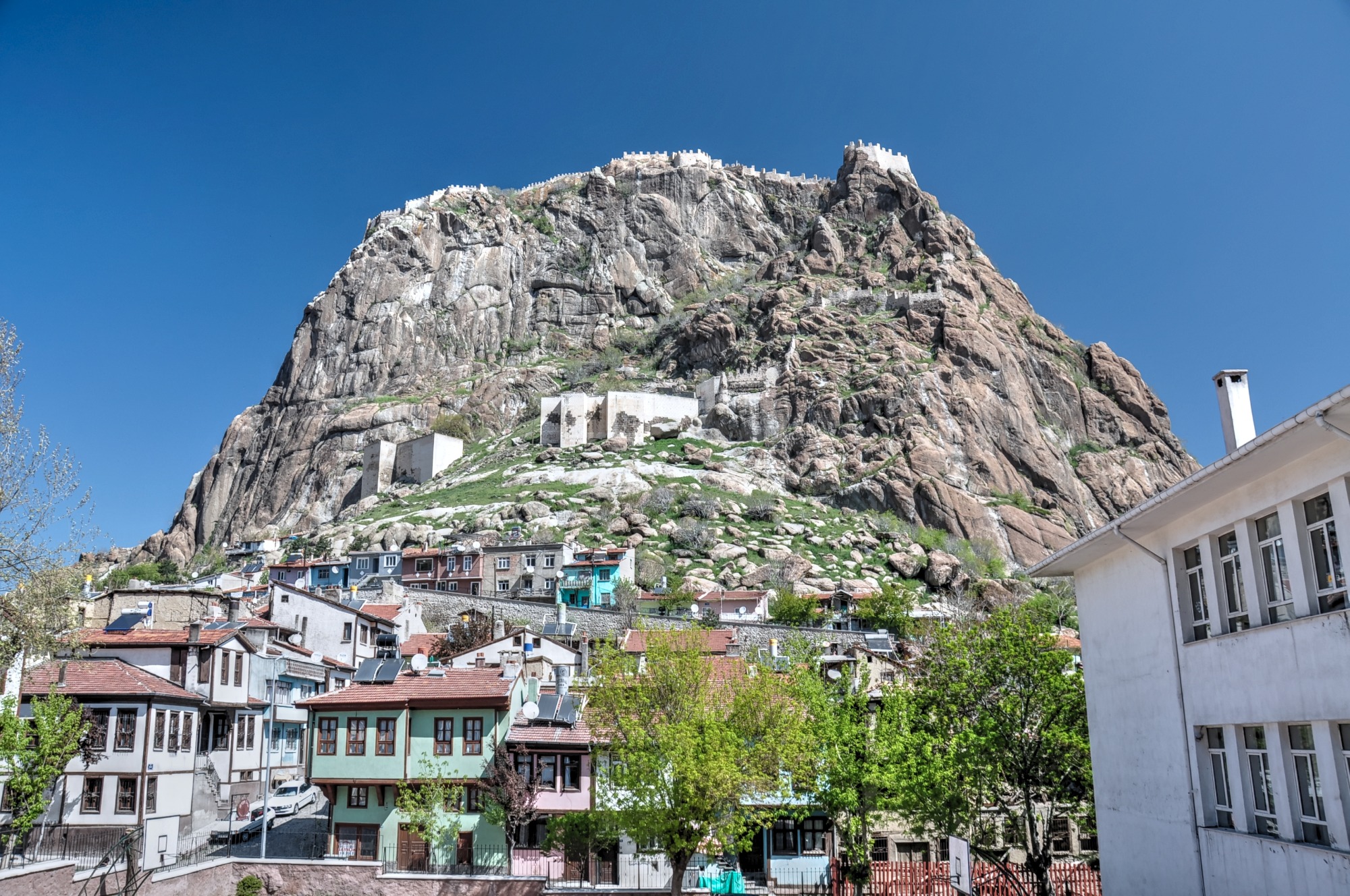
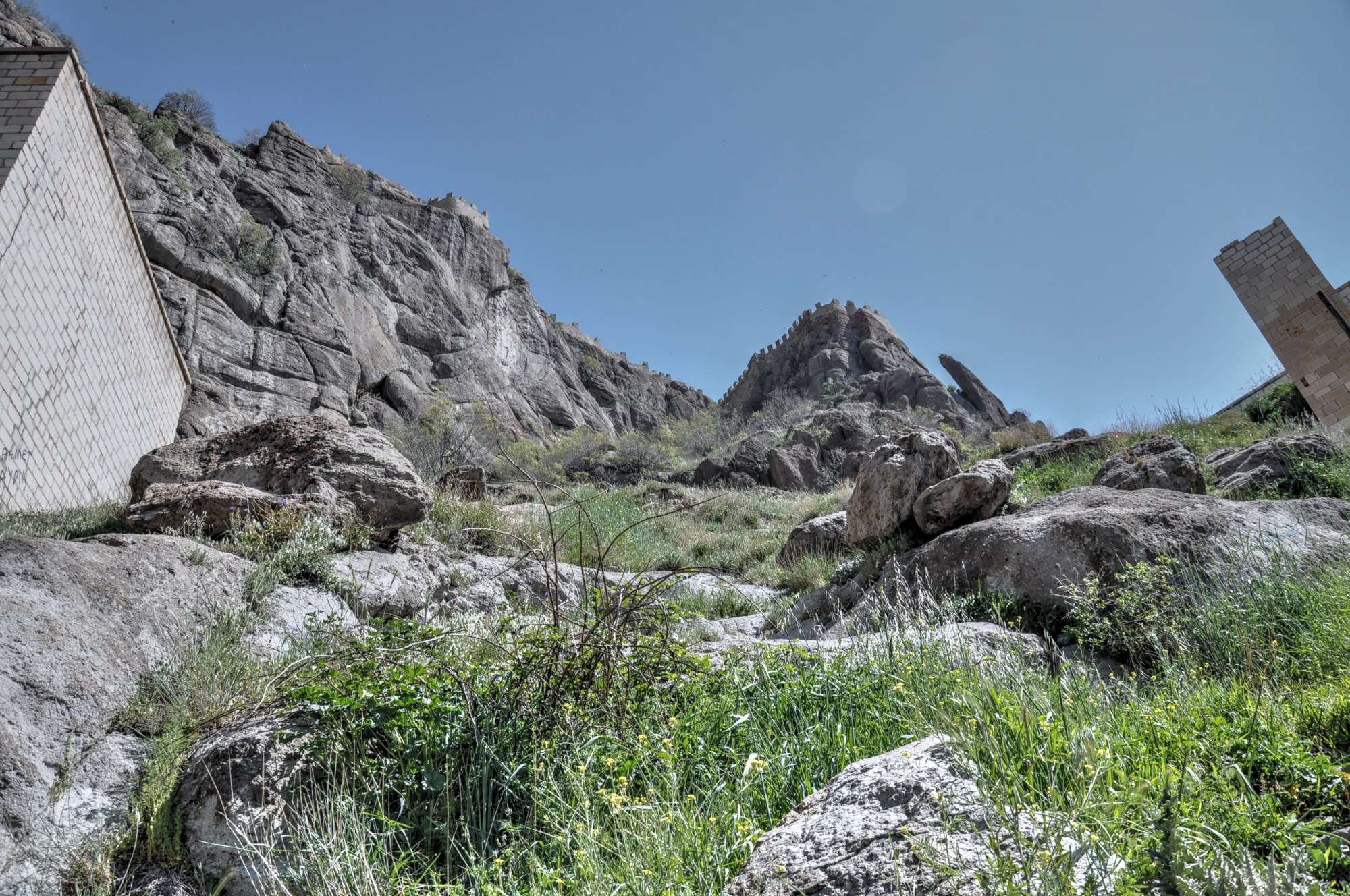
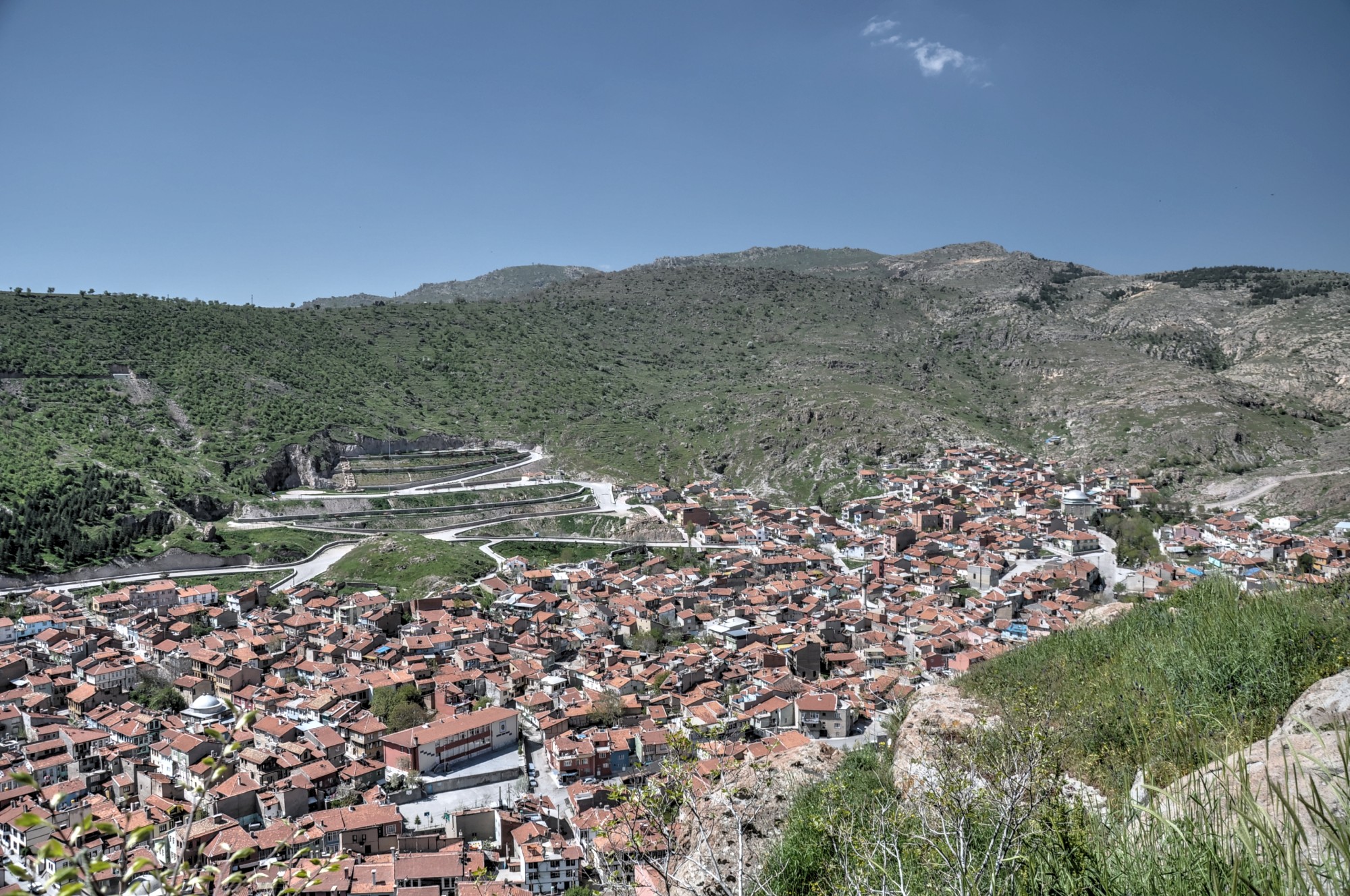
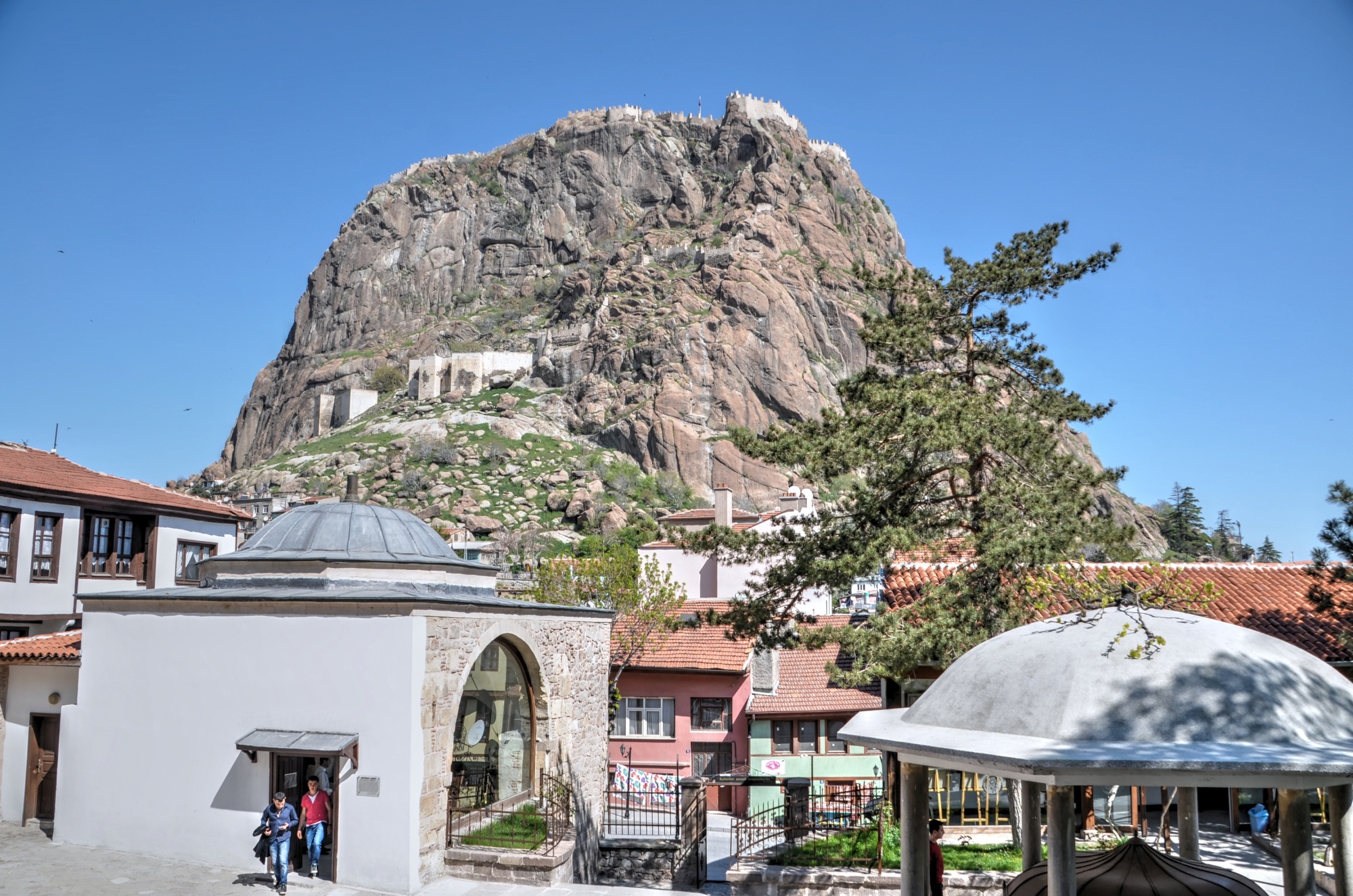
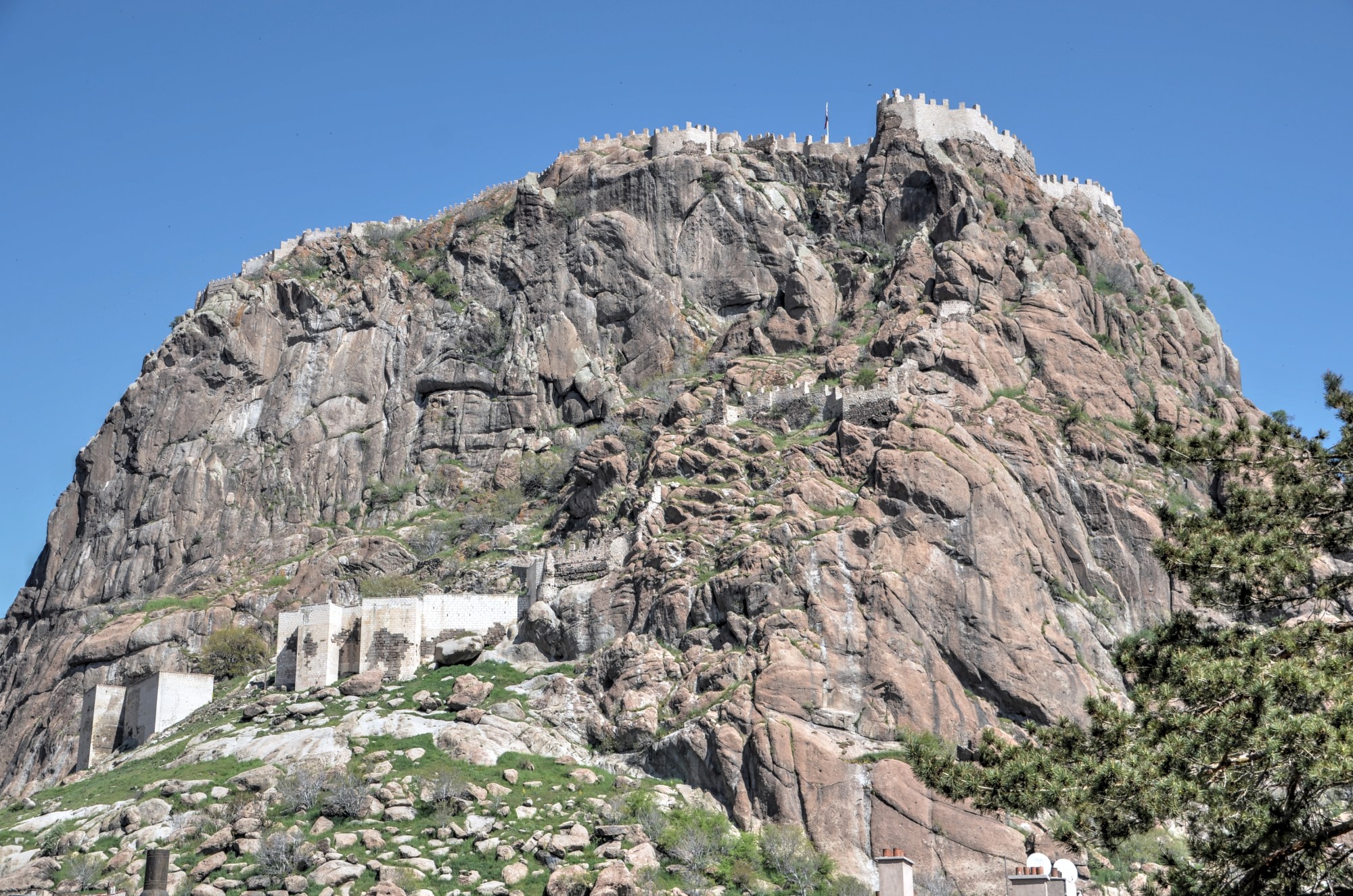
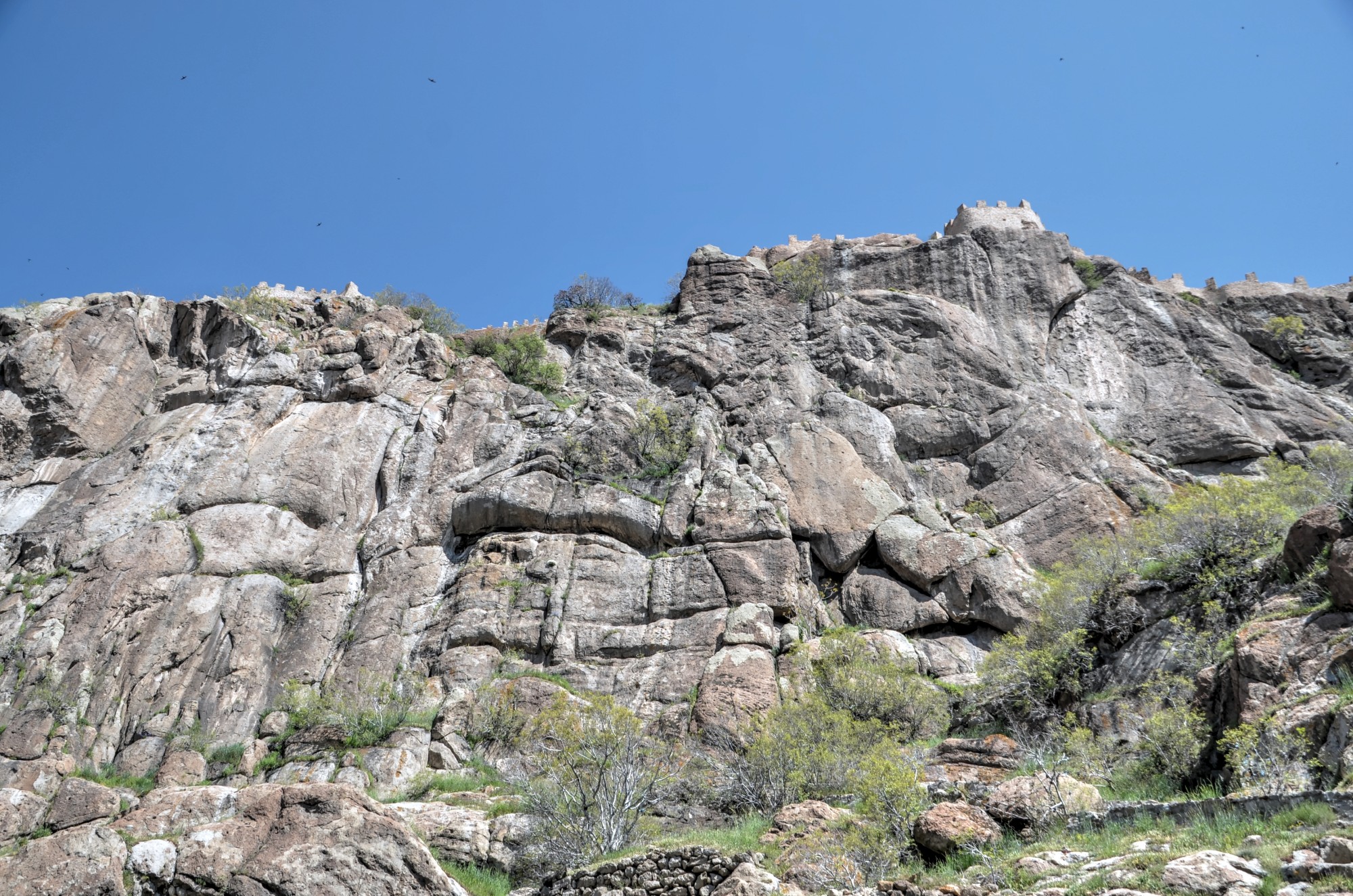
Afyonkarahisar Castle (Afyonkarahisar Kalesi), also known as Karahisar Castle, is a historic fortress rising above the centre of Afyonkarahisar in western Türkiye. It occupies the summit of a steep, isolated volcanic rock formation that dominates the surrounding urban landscape. The rocky outcrop rises approximately 226 metres above the city and offers extensive views over the historic centre and the surrounding plains. The castle is one of the most recognisable landmarks of Afyonkarahisar, and its name is closely connected with the city's own name.
The city's name combines two elements: Afyon, the Turkish word for opium, reflecting the region's long-standing cultivation of the opium poppy, and Karahisar, meaning "Black Fortress", a reference to the castle built on the dark volcanic rock above the city. The settlement was formerly known as Karahisar-ı Sahib, a name associated with the Seljuk statesman Sahip Ata Fahreddin Ali. The combined name Afyonkarahisar thus reflects both the region's agricultural history and its most prominent landmark.
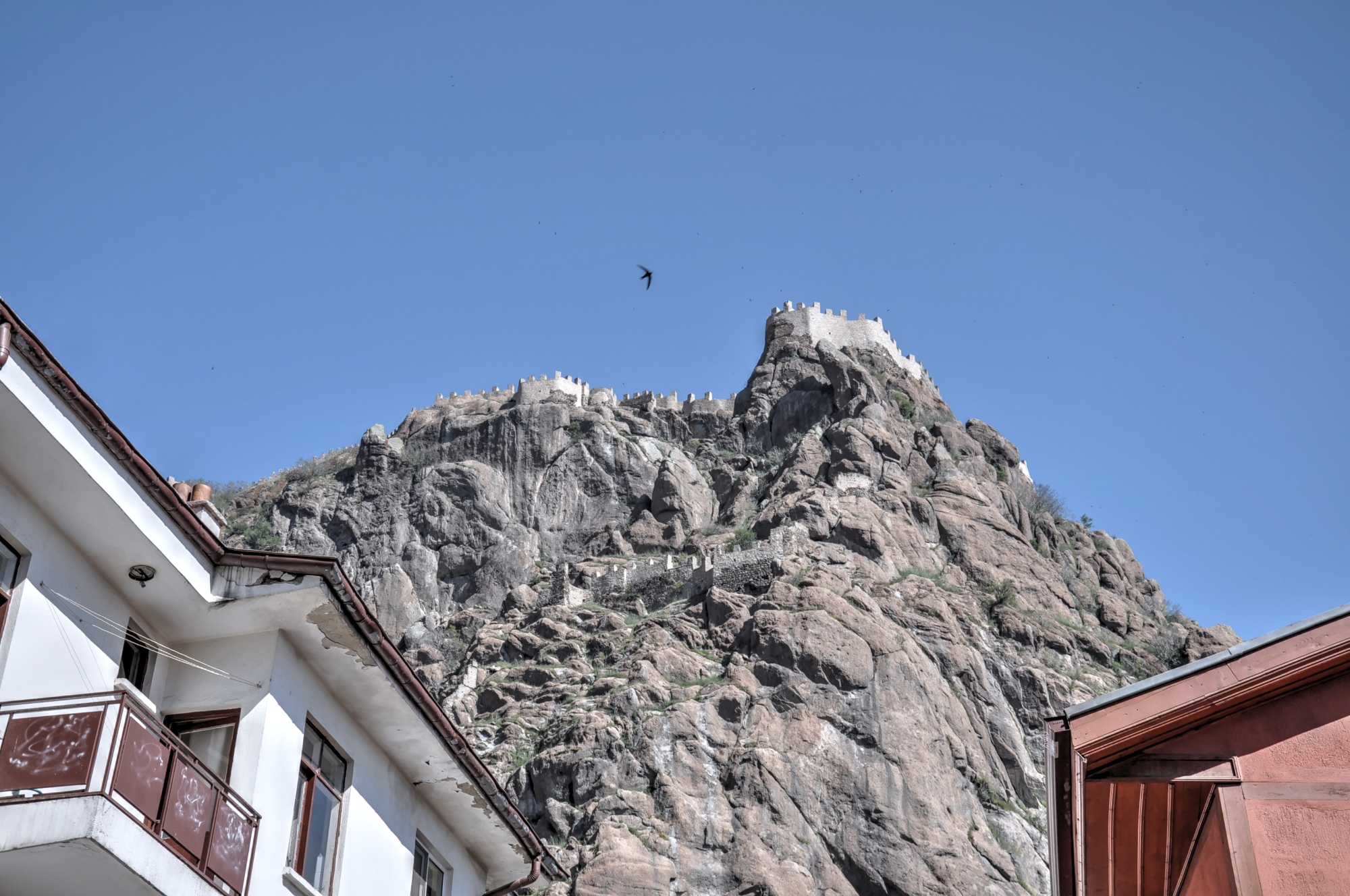
The fortress has a long and complex history, traditionally traced back to the Hittite period. Its summit preserves evidence of several successive phases of occupation and use, including Phrygian rock-cut features and places of worship dedicated to the Mother Goddess Kybele, as well as large water cisterns and remains associated with the Byzantine and Seljuk periods. The castle was substantially repaired during the reign of the Seljuk sultan Alaeddin Keykubad in the thirteenth century and underwent further restoration during the Ottoman period.
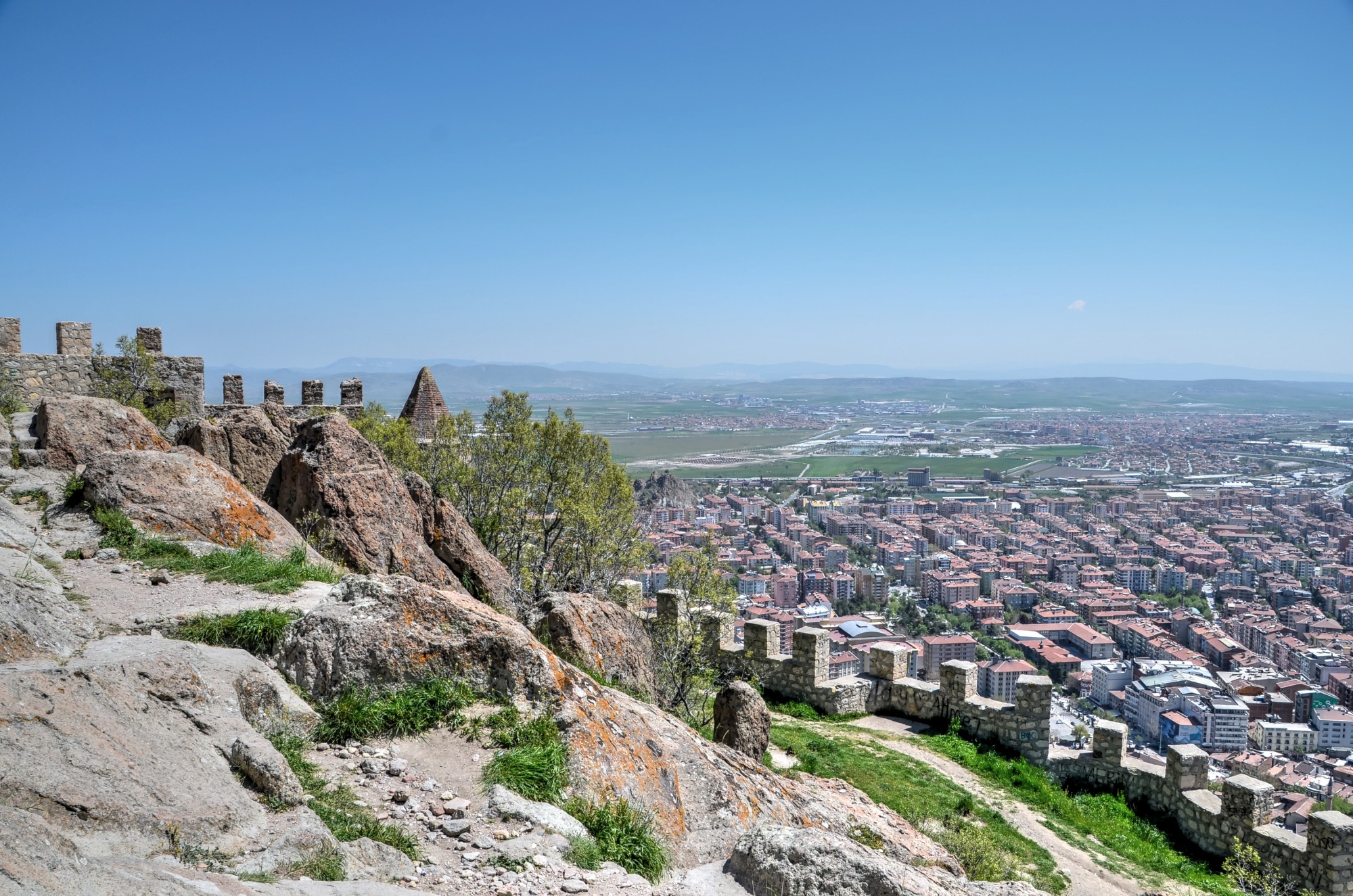
Today, Afyonkarahisar Castle is both an important archaeological and historical monument and a spectacular viewpoint over the city. Its remains include traces of ancient religious practices, defensive structures, water-storage installations, and medieval buildings. The climb to the summit is demanding, but the fortress provides an opportunity to explore the city's long history in a setting that remains one of the defining features of its urban landscape.
Historical overview
Hittite period
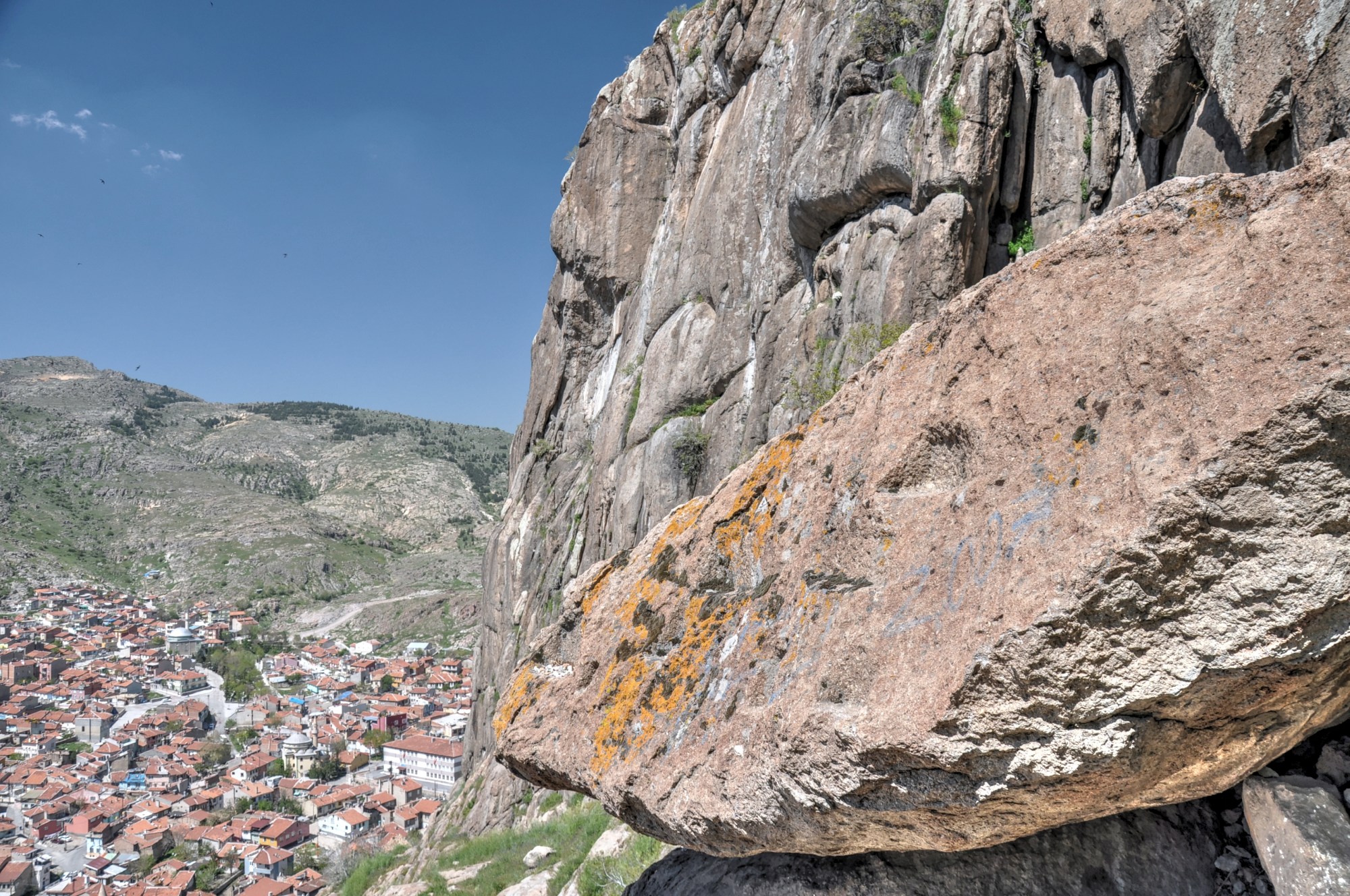
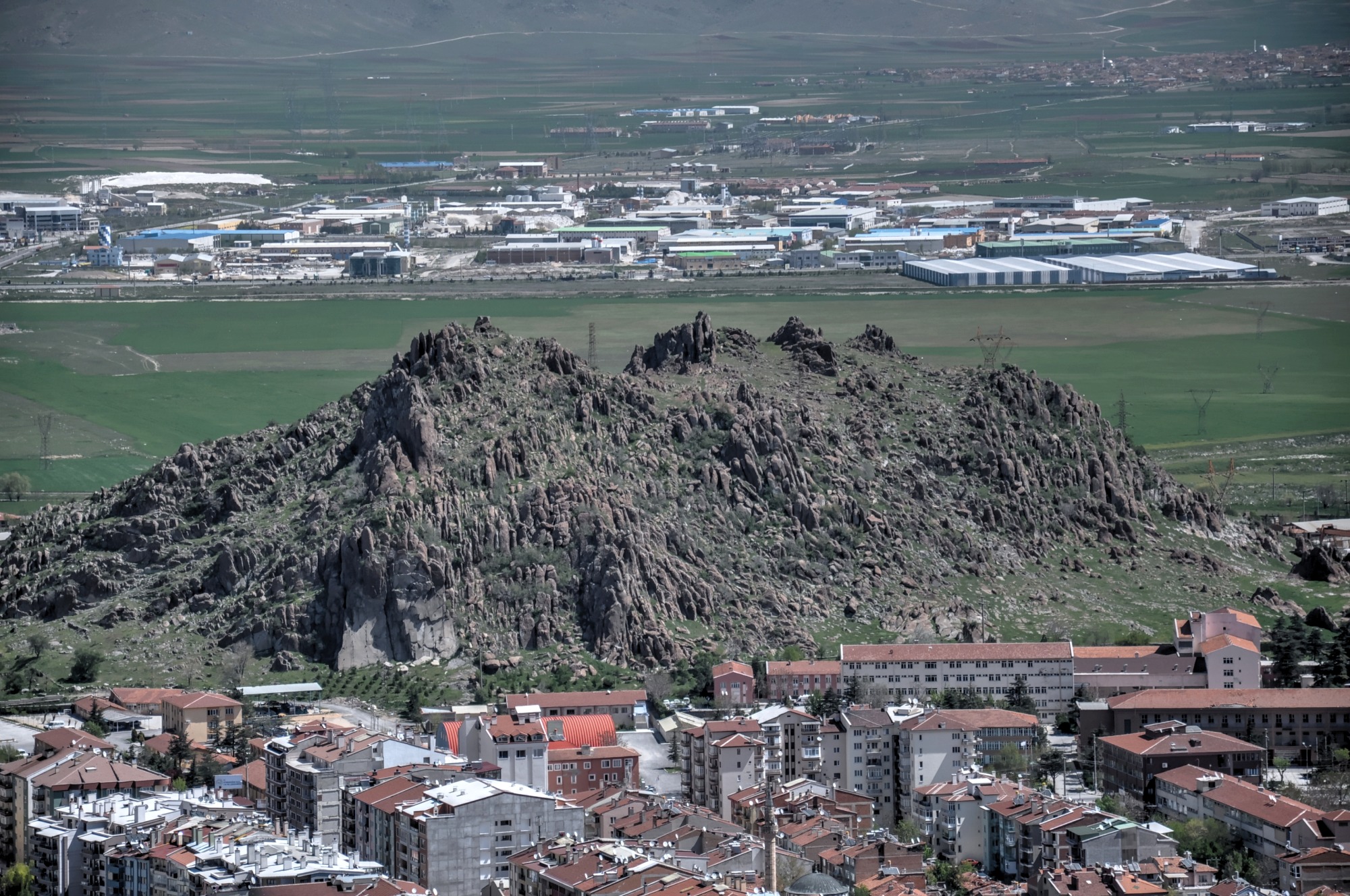
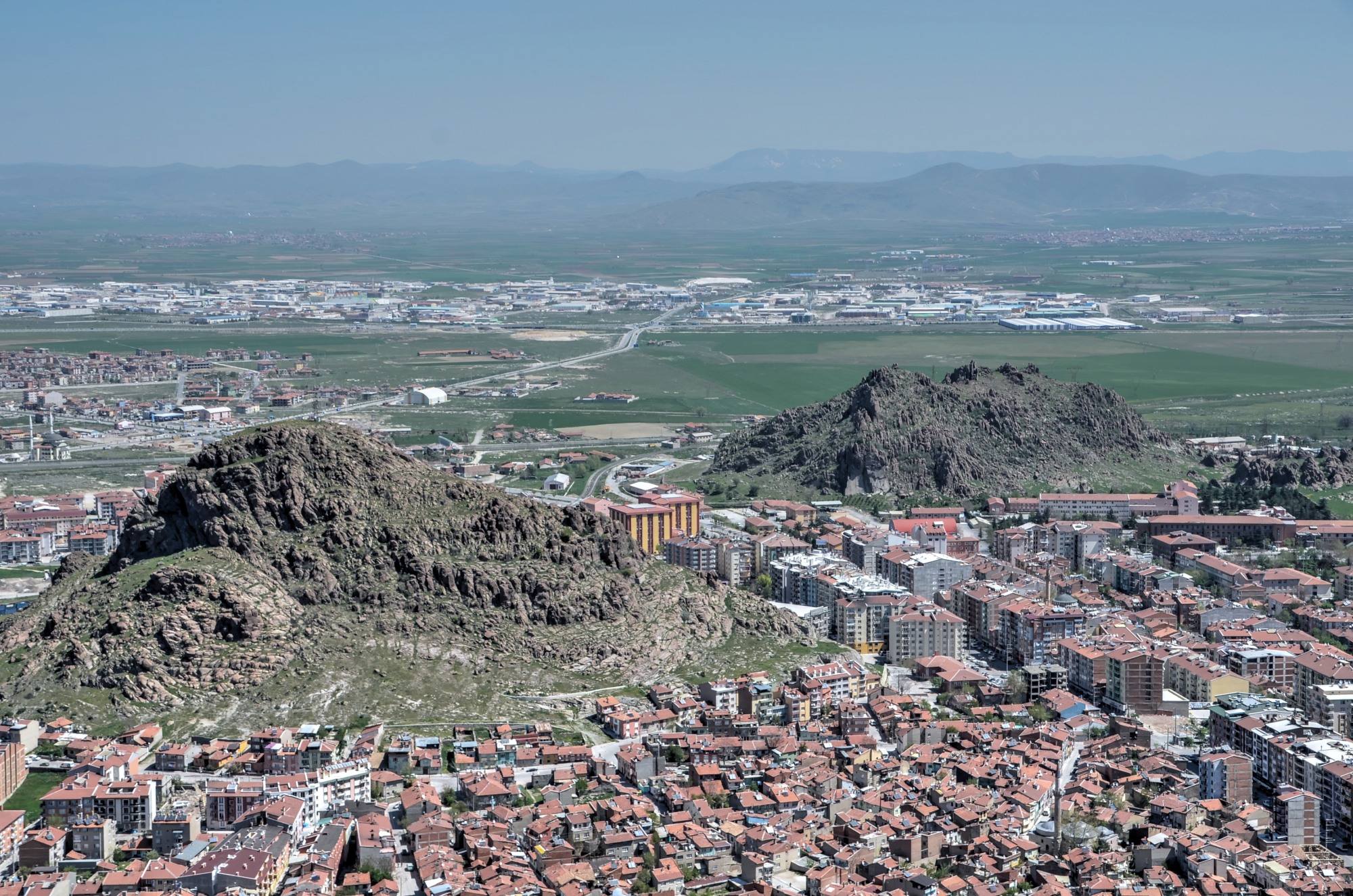
The rocky outcrop on which Afyonkarahisar Castle stands is itself of considerable geological age. It consists of trachytic andesite, also known as trachyandesite, a volcanic rock formed during the Miocene, when extensive volcanic activity affected the Afyonkarahisar region. Radiometric dating of volcanic rocks from the wider area indicates that this activity took place approximately 8.5–14.5 million years ago. The castle's rock has a porphyritic texture, with conspicuous crystals of minerals such as sanidine, biotite, and plagioclase embedded in a finer-grained matrix. Its internal structure preserves traces of the original lava flow, as well as fractures formed during cooling.
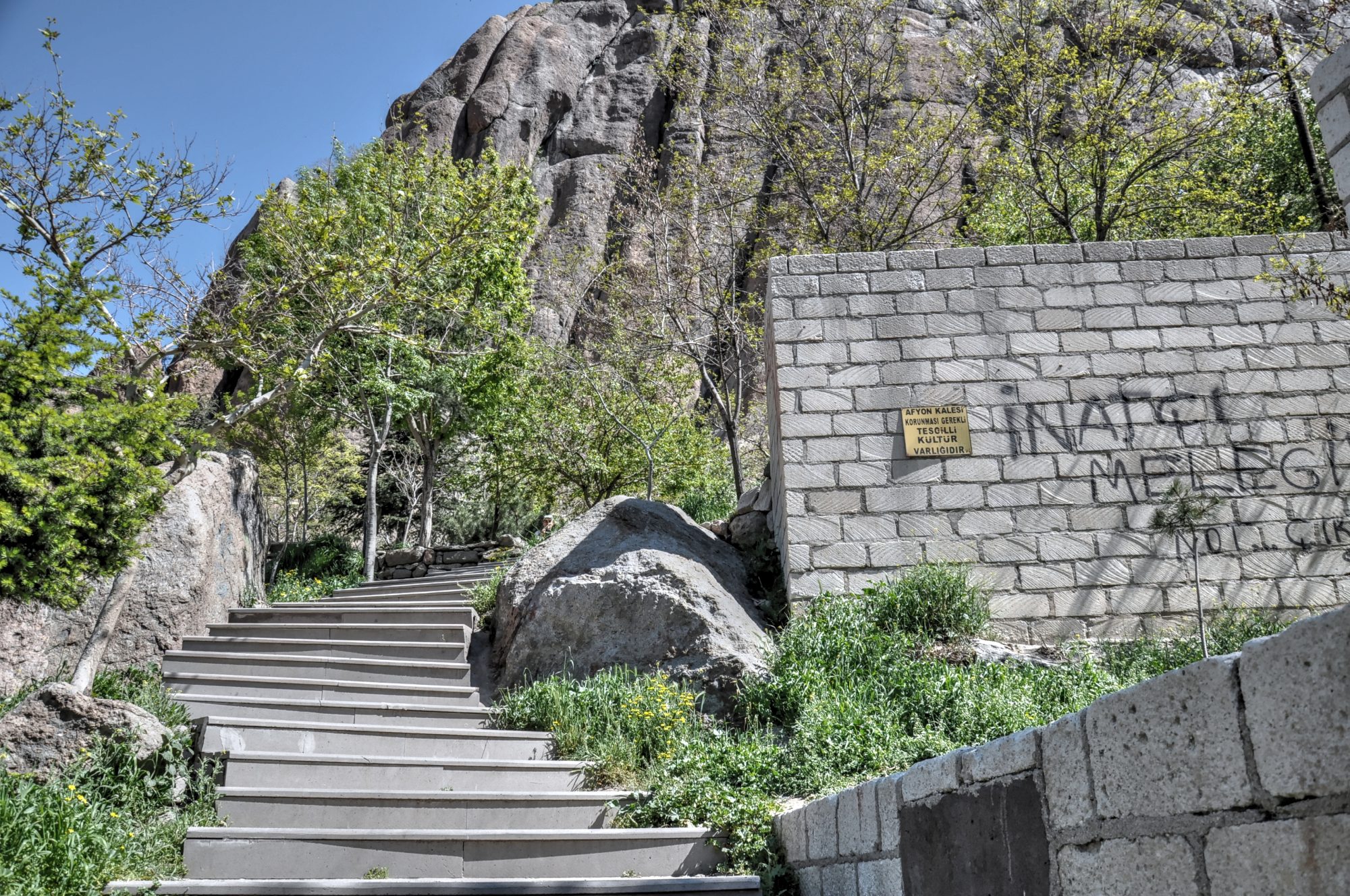
The rock's resistance to erosion is likely to have contributed to the hill's striking appearance. Over millions of years, erosion of the surrounding geological materials would have helped expose and accentuate the more resistant volcanic mass, leaving it as a steep, isolated eminence above the surrounding landscape.
Afyonkarahisar Castle has a long history of occupation, although the precise date of its foundation and the identity of its earliest builders remain uncertain. Local historical accounts traditionally attribute its establishment to the Hittite king Mursili II around 1350 BCE, during his campaign against Arzawa in western Anatolia. According to this account, the rocky outcrop was used as a fortified position and was known as Hapanuva, usually interpreted as "High Place" or "City on the High Hill". The castle's exceptionally strong natural position would certainly have made it suitable for defensive purposes.
However, the traditional date and royal attribution should be treated cautiously: they are repeated in local and official publications, but the available evidence does not independently establish that Mursili II founded the fortress in that particular year. Indeed, conventional Hittite chronologies generally place his reign around 1330–1295 BCE (middle chronology) or 1321–1295 BCE (short chronology), making the frequently quoted date of 1350 BCE problematic. The earliest phase of the fortress should therefore be discussed in terms of the Hittite presence and the reported early fortifications rather than as a securely dated royal foundation.
The traditional association of Afyonkarahisar Castle with Mursili II is linked to the Hittite king's campaigns against Arzawa in western Anatolia, undertaken during the third and fourth years of his reign, conventionally dated to approximately 1306–1305 BCE. At the beginning of his reign, Mursili faced widespread unrest among territories subject to Hittite authority. One of the most serious challenges came from Arzawa, whose ruler, Uhha-Ziti, refused to surrender political fugitives from Attarimma, Huwarsanassa, and Suruta who had sought refuge in his kingdom. Mursili interpreted this refusal as a challenge to Hittite authority and personally led a major military expedition against Arzawa. The campaign lasted two campaigning seasons and resulted in the defeat of Uhha-Ziti, who fled overseas. The Hittite army captured Apasa, generally identified with Ephesus, and subsequently subdued other centres, including Puranda.
The campaign was followed by a reorganisation of political control across western Anatolia. In the fourth year, after returning from the territory of the Seha River Land, Mursili intervened in the neighbouring kingdom of Mira, where he restored order and strengthened a number of existing settlements. According to the Hittite annals, he rebuilt and fortified Arsani, Sarawa, and Impa, providing them with garrisons, while Hapanuwa was also given a military garrison. These measures formed part of a broader settlement under which several western Anatolian territories, including Mira, the Seha River Land, and Hapalla, were placed under rulers bound to the Hittite Great King by treaties. The campaign was therefore not simply a military expedition: it was followed by the establishment of a more closely controlled network of local vassal kingdoms and fortified positions.
The connection between these events and Afyonkarahisar Castle, however, is not certain. Some modern Turkish publications identify the fortress with Hapanuwa and state that Mursili II used the rocky outcrop as a fortified position during the Arzawa campaign. Yet the identification of the Hittite town of Hapanuwa remains disputed. In a detailed study of the historical geography of the Arzawa lands, archaeologist Recep Meriç places it among the settlements of Mira, probably on the southern slopes of Mount Tmolos (modern Bozdağ), in the Kaystros (Küçük Menderes) river basin. His reconstruction therefore locates it considerably farther west than Afyonkarahisar. Meriç also emphasises that Mursili fortified and garrisoned existing towns rather than founding them. Consequently, although the strategic position of the Afyonkarahisar rock makes its use as a Hittite strongpoint plausible, the identification of the castle with Hapanuwa, or its direct association with Mursili's Arzawa campaign, should not be presented as an established fact.
Phrygian times
Following the collapse of the Hittite Empire around 1200 BCE, western and central Anatolia underwent major political and cultural changes, and the Phrygians gradually emerged as one of the region's most influential peoples. Their earlier homeland is traditionally placed in the Balkans. Herodotus (7.73), reporting a Macedonian tradition, states that the Phrygians had formerly been known as Briges (or Bryges) while living in Europe near the Macedonians, and that they adopted the name Phrygians after migrating to Asia. Modern scholarship generally places the appearance of Phrygian-speaking groups in Anatolia in the Early Iron Age, approximately 1200–1000 BCE. Nevertheless, the precise nature and scale of this movement remain debated. Recent research cautions against treating the formation of Phrygian culture and the state centred at Gordion as the result of a single migration by a clearly defined population. It is more appropriate to understand Phrygian identity as having developed through a complex process involving incoming groups and the existing communities of Anatolia. The Afyonkarahisar region became part of the western Phrygian cultural sphere.
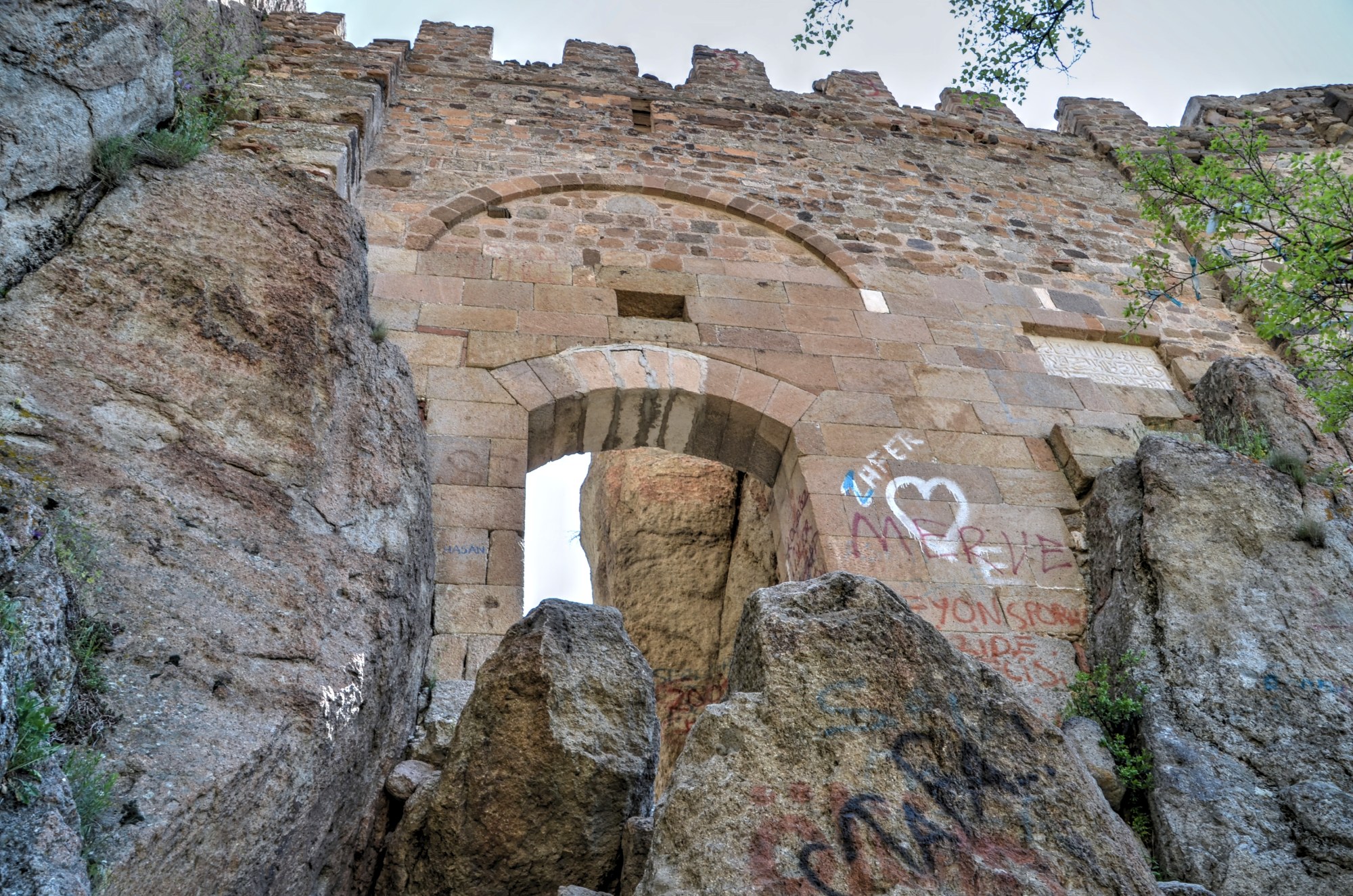
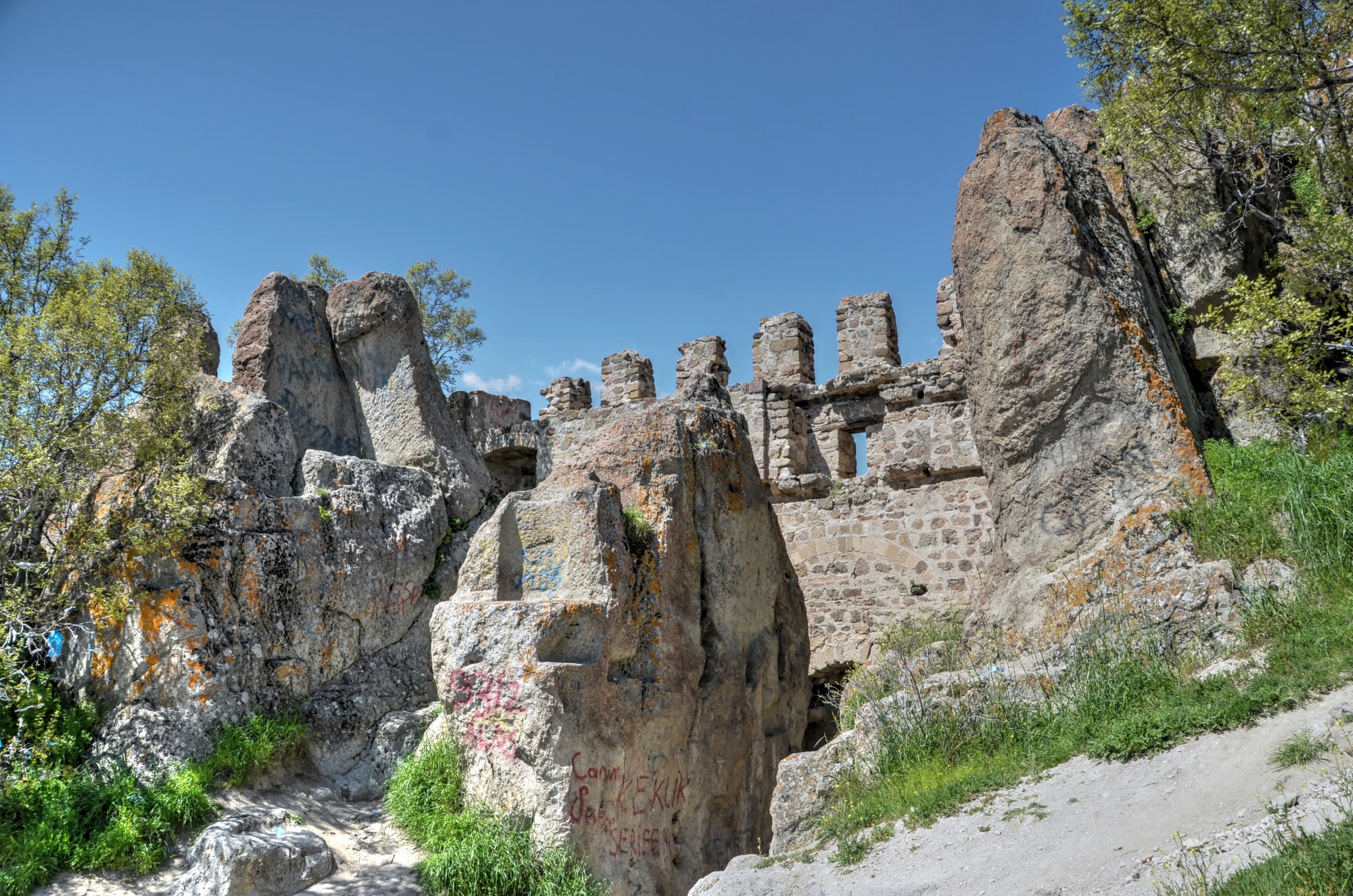
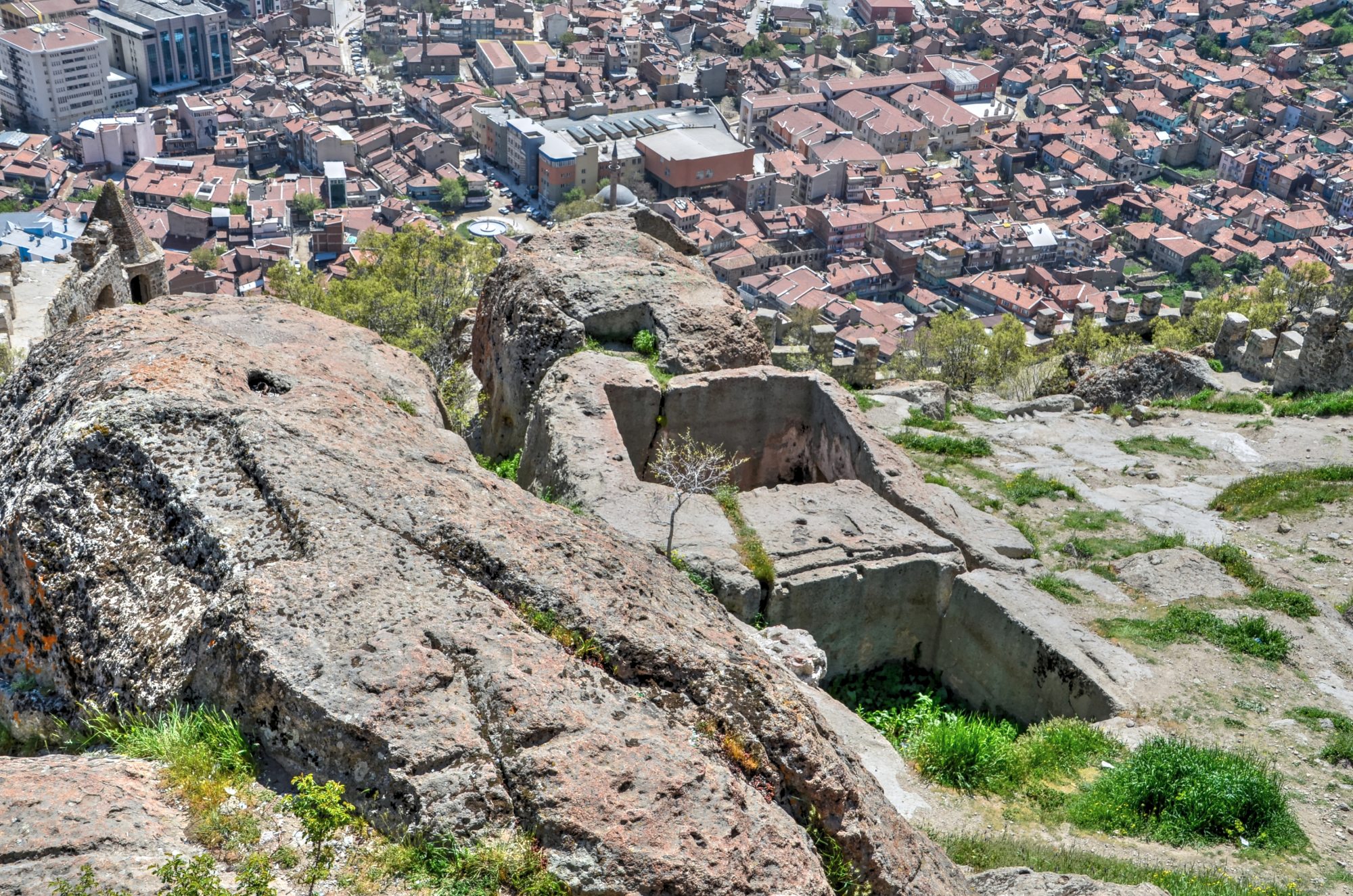
The summit of Afyonkarahisar Castle preserves traces of religious activity traditionally attributed to the Phrygian period. These include a rock-cut cult area, niches, offering pits, and a stepped monument commonly described as an altar. The latter is situated on the relatively level ground near the entrance to the Upper Castle. Research into the castle's architectural remains also records a rock-cut cult installation, a path carved into the stone, and rock steps in the area around the summit. Some of these features have been damaged or altered by later repairs, making their original appearance and precise function difficult to reconstruct. The stepped monument is particularly significant because it belongs to a wider tradition of religious installations associated with prominent rocky outcrops in western and central Anatolia.
The religious significance of the site can be understood in the context of the Phrygian worship of the Mother Goddess, whose name in Phrygian inscriptions was Matar, meaning "Mother". The goddess is also associated with the epithet Kubileya or Kubeleya, generally regarded as the linguistic origin of the Greek name Kybele and its Latin form Cybele. In her original Phrygian context, Matar was closely connected with mountainous landscapes and wild nature. Modern scholarship has also emphasised her association with power and royal authority, suggesting that her role extended beyond the more familiar later image of a fertility goddess. Her cult was established in natural settings, particularly on mountains and rocky heights, which were considered appropriate places for encountering the divine.
Rock-cut sanctuaries were among the most distinctive expressions of this cult in the Phrygian highlands between Afyon and Eskişehir. Some were carved directly into volcanic rock and designed to resemble the façade of a building, usually with a niche as the central feature. The niche was presumably intended to contain an image of the goddess; in certain sanctuaries, her figure was carved directly into the rock and remains in place. Other religious installations consisted of simpler niches or stepped monuments. The prominent position of many such monuments, often on exposed rocky ridges, was an important part of their setting. The sanctuary on the Afyonkarahisar summit belongs to this broader regional tradition, although its individual features cannot all be assigned a specific ritual function with certainty.
The stepped monument deserves particular caution in interpretation. It has traditionally been called a Phrygian altar and associated with the worship of Matar. However, recent research by Michele Massa and James Osborne points out that the precise religious significance of this type of monument remains uncertain. A connection with the cult of Matar is widely assumed, but the monuments are often difficult to date accurately, and their function cannot always be established from their form alone. The stepped installation at Afyonkarahisar should therefore be described as a cult monument traditionally interpreted as an altar, rather than as an altar whose precise function has been conclusively demonstrated.
The origin of the ancient name of the sites sometimes associated in some local historical accounts with a Phrygian king called Akroneos, who supposedly gave the settlement its name. However, this claim remains unverified. It appears in modern local-history accounts, including the historical overview published by the Afyonkarahisar Municipality, but no ancient author, inscription, or archaeological evidence has been cited to establish the existence of such a ruler. Akroneos is likewise absent from the specialist literature on Phrygian history, epigraphy, and the ancient geography of the region, suggesting that the story may represent a local historical tradition or an antiquarian interpretation of the place-name rather than a documented historical fact.
Later antique period
During the Roman and Byzantine periods, the settlement is associated with the names Akroinon and Akroinos, forms documented in historical, geographical, and epigraphic scholarship. The earliest possible epigraphic clue comes from inscriptions recording donations to the sanctuary of the Xenoi Tekmoreioi near Antioch in Pisidia, which include the ethnic form Akroēnoi, apparently referring to the inhabitants of a community. William Mitchell Ramsay identified these people with a settlement at the site of modern Afyonkarahisar, an interpretation subsequently discussed by Claude Brixhe and Thomas Drew-Bear, although the identification has not been universally accepted. According to these scholars, the settlement was apparently only a village during the Roman period, while Prymnessos was the principal urban centre in the surrounding area.
The name Akroinos, meanwhile, is well documented in Byzantine historical sources and ecclesiastical records, when the rocky citadel of Afyon acquired greater strategic importance. The variants Akroinon and Akroinos are used by modern scholars according to different philological and editorial conventions rather than necessarily representing successive names. The origin of the name itself remains uncertain. Brixhe and Drew-Bear consider a possible connection with the Greek root akr-, found in words such as akra and akros, associated with a point, extremity, or elevated place. Such an interpretation would be appropriate for the conspicuous rocky summit crowned by the citadel.
However, the root may also have been inherited from the Phrygian language, while the formation of the name could reflect a combination of Greek and earlier Anatolian linguistic elements. Its association with a high or elevated place is therefore plausible, but cannot be regarded as a definitive etymology. Other forms, including Akronio and Akronium, are frequently repeated in modern local historical accounts, although their specific ancient textual or epigraphic sources remain uncertain. Similarly, the local tradition attributing the name to a Phrygian king called Akroneos has not been substantiated by reliable historical or archaeological evidence.
Afyonkarahisar's Byzantine history is closely connected with the strategic importance of its rocky citadel and its position along routes linking Constantinople with the eastern provinces of the Byzantine Empire. The most reliable scholarly account specifically addressing the city's Byzantine history is the entry in the Tabula Imperii Byzantini, supplemented by the study of Jean-Claude Cheynet and Thomas Drew-Bear published in 2004. The latter identifies Akroinos, modern Afyonkarahisar, as an important communication junction on the route to Constantinople for travellers arriving from Syria. This strategic position made the city particularly vulnerable to military incursions, especially during the period of Arab campaigns into Anatolia. The authors state that the fortress was already strongly fortified by at least the eighth century, when Arab raiding forces repeatedly used this route.
Akroinos was exposed to Arab military expeditions during the eighth century. The city lay along a route used by armies advancing from Syria towards Constantinople, and the repeated incursions made the fortress an important element of the Byzantine defensive system in western Anatolia. Akroinon is associated with Arab attacks in 716 and 732, while the surrounding region became the setting for the major Byzantine victory of 740, known as the Battle of Akroinon. Emperor Leo III and his son Constantine, later Constantine V, defeated an Umayyad army in this battle. Although the battle is conventionally associated with Akroinon, it should not be assumed that it was fought directly at the castle or within the settlement itself. The victory was an important event in the wider Byzantine-Arab conflict over Anatolia.
The Byzantine period also saw the development of Christian institutions in Akroinos. The city's episcopal status is confirmed by epigraphic evidence, and a particularly important inscription studied by Cheynet and Drew-Bear records the renovation of a church dedicated to the Archangel Michael by Bishop Niketas during the reign of an emperor named Constantine Porphyrogenitus, most probably Constantine VII (945–959). The inscription, discovered in Afyonkarahisar and preserved in the city's museum, was originally part of the church's templon architrave. It provides direct evidence of ecclesiastical activity and the local cult of Saint Michael during the middle of the tenth century, although it does not establish the location of the church within the settlement. The remains of a possible Byzantine church on the summit of the castle have also been reported in local archaeological and architectural studies, but their identification and dating require further confirmation.
The defensive importance of Akroinos continued into the early twelfth century, when the fortress was still maintained as a garrison capable of resisting Turkish incursions. In 1108, during a period when Byzantine forces were also confronting Pisan raids in the Aegean, Michael of Amastris, the commander responsible for the defence of Akroinos, rebelled against Emperor Alexios I Komnenos. According to Anna Komnene, Michael seized the fortress and plundered the surrounding territory. The emperor dispatched Georgios Dekanos, who quickly recaptured the city and arrested the rebel. Michael was subsequently taken to Constantinople, where Alexios initially threatened him with execution but ultimately pardoned him and bestowed gifts upon him. Anna does not explain the reasons for the rebellion, and the episode remains one of the few recorded incidents illustrating the political and military unrest affecting the fortress during the late Byzantine period.
Seljuk rule
The arrival of the Seljuks marked a major turning point in the history of the fortress and the settlement below it. Local accounts differ slightly over the precise date of the conquest. One municipal history places the capture in 1147, during the reign of Sultan Mesud I, while another account associates the incorporation of the area into Seljuk territory with the reign of Malik-Shah in the late eleventh century. The exact sequence of events therefore requires further verification. What is clear is that Afyonkarahisar became an important Seljuk stronghold, benefiting from its position near the intersection of major routes across western Anatolia. The settlement expanded around the fortress, and the castle acquired the name Karahisar, meaning "Black Fortress", after the dark volcanic rock on which it stands.
A major reconstruction took place during the reign of Sultan Alaeddin Keykubad I (1220–1237). In 1231, the sultan reportedly sent Bedrettin Gevhertaş, a prominent Seljuk official entrusted with the castle's administration and defence, to Afyonkarahisar to undertake extensive repairs. The works were so substantial that the castle is said to have been almost entirely rebuilt. Its defensive and architectural layout was organised into three principal levels: the Lower Castle, the Middle Castle, and the Upper Castle. The upper section included a palace, a small mosque, and other structures, while the lower and middle sections contained residential buildings, guard quarters, storage facilities, and a dungeon. An inscription preserved at the castle refers to Alaeddin Keykubad using the honorific titles Al-sultan al-mu'azzam ("the Great Sultan") and Ala' al-Dunya wa'l-Din ("Exaltation of the World and Religion"). Although the inscription is undated, it provides epigraphic evidence for the sultan's association with the fortress and can be attributed to his reign. The castle also served as a repository for the Seljuk state treasury, a role reflected in the name Karahisar-ı Devle, meaning "Black Fortress of the State".
Following the decline of Seljuk power after the Mongol victory at Köse Dağ in 1243, Afyonkarahisar came under the authority of regional Anatolian principalities, initially becoming closely associated with Sahip Ata Fahreddin Ali and his descendants, the Sahibataoğulları. Sahip Ata spent much of his life in Afyonkarahisar, which became an important centre of his family's power and was named Karahisar-ı Sahib in his honour. The principality remained influential in the town into the fourteenth century, although its territories gradually diminished and the political situation became increasingly shaped by its dynastic ties with the neighbouring Germiyanids. Following the death of Ahmed Bey, members of the Sahibata family became increasingly dependent on the Germiyanid rulers, and Afyonkarahisar eventually passed under Germiyanid control, commonly dated to 1341. During this period, the castle continued to serve as a residence and administrative centre for local rulers, while the wider region saw the construction and renovation of fortifications, mosques, madrasas, caravanserais, tombs, and other monumental buildings.
Afyonkarahisar was temporarily incorporated into the Ottoman domains in 1390 under Sultan Bayezid I, but following the Ottoman defeat at the Battle of Ankara in 1402, Germiyanid rule was restored. The town remained under the authority of Germiyan until the death of its last ruler, Yakub II, in 1429. Yakub had arranged for his principality to pass to the Ottoman Sultan Murad II, and Afyonkarahisar was consequently incorporated into the Ottoman Empire again, this time permanently, in accordance with his testamentary arrangements. Throughout these successive changes of rule, the castle retained its political and defensive importance, although the surviving remains do not allow the architectural contributions of each dynasty to be clearly distinguished.
Ottoman period
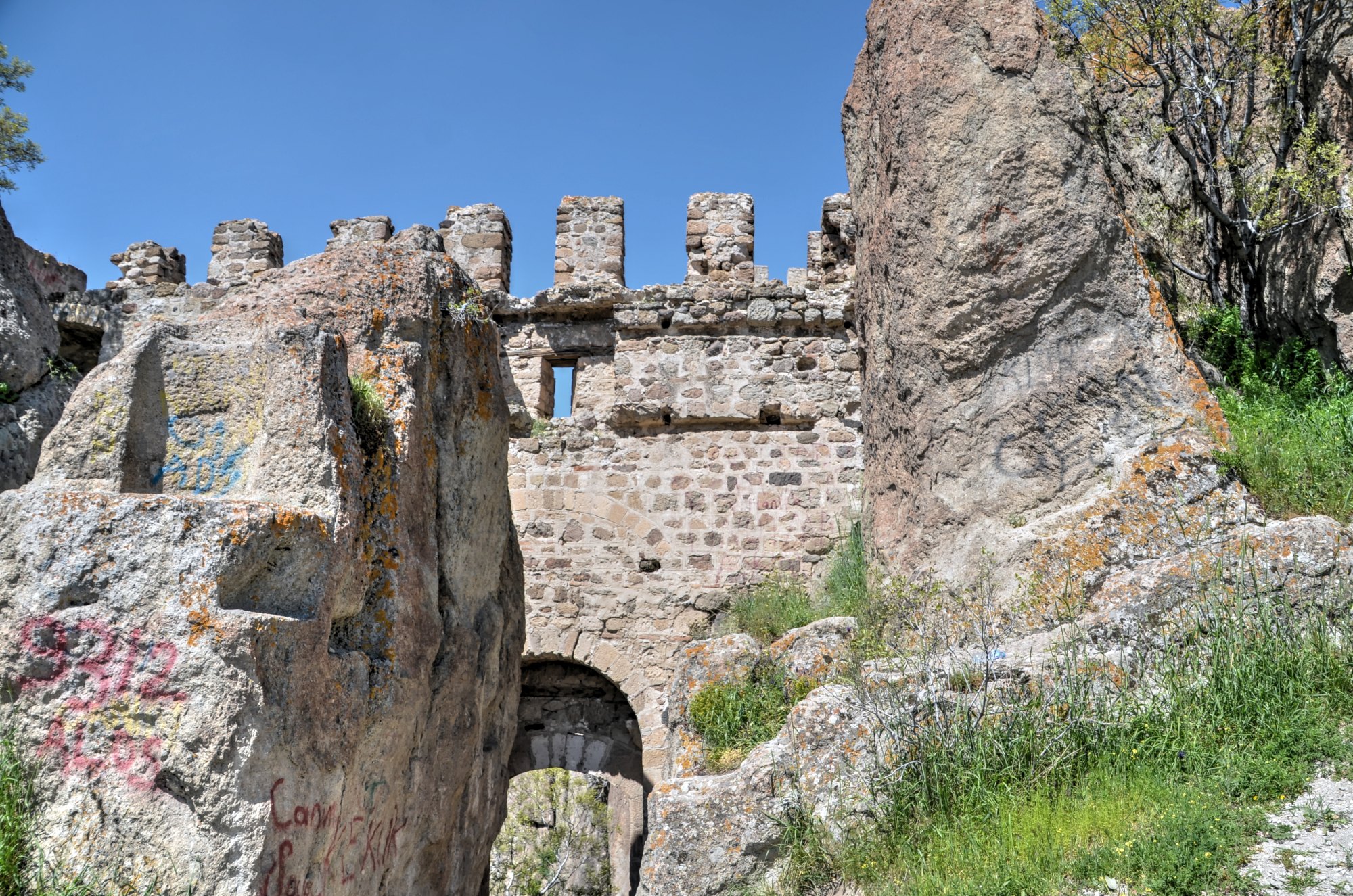
Under Ottoman rule, the fortress gradually lost much of its earlier military importance, although it continued to serve practical administrative and security functions. It was used to store valuables belonging to local inhabitants, particularly during periods of unrest or the threat of attack, and also served as a place of confinement for prisoners. A garrison and staff responsible for maintaining and guarding the castle remained in place. One of the most significant Ottoman restoration campaigns took place in 1573, during the reign of Sultan Selim II. The works, carried out under the supervision of Mahmud Bey, included repairs to the fortress, and a marble inscription commemorating the restoration was placed above the entrance gate.
The castle was visited by the Ottoman traveller Evliya Çelebi in 1671-1672, who devoted a detailed description to it in his "Seyahatname". He portrayed Karahisar-ı Sahib as a massive, six-level fortress rising above the surrounding city, and described the arduous ascent from the Lower Castle entrance to the mosque at the summit, which took him two hours. Within the Inner Castle, he recorded the Sultan Keykubad Mosque, whose tiled mihrab and stone minbar he praised, noting that its minaret had collapsed in an earthquake. He also mentioned three grain-storage buildings, arsenals, and seven or eight cisterns, as well as the Kırklar shrine beside the mosque. Although the Inner Castle was largely deserted, its vaulted chambers and caves continued to serve as storage places for valuables belonging to wealthy local families, protected by guards who maintained round-the-clock watches in teams of ten. The Middle Castle contained a hall for administrative or reception purposes, a mosque, and the residence of the fortress keeper, while a lower fortified section accommodated several dozen houses.
Evliya's account also provides a vivid picture of the town below the castle. He estimated that Afyonkarahisar contained approximately 4,600 Muslim households and around 1,000 Christian households, with substantial houses built of stone and mudbrick, many incorporating guest rooms, courtyards, stables, gardens, and private quarters. He recorded 2,048 shops, 19 commercial inns, three madrasas, more than 200 fountains, numerous mosques, and several bathhouses. The city's commercial life was particularly associated with leatherworking and saddlery, which he praised for their quality and reputation. His account also highlights Afyonkarahisar's hospitality towards travellers, its religious institutions, and the prominence of scholars, providing a valuable, if occasionally exaggerated, picture of the city and its fortress in the late seventeenth century.
Following Evliya Çelebi's visit, the castle gradually lost much of its former military and administrative importance, although it continued to be regarded as a prominent landmark and a remnant of the city's earlier defensive system. Evidence from later travellers provides occasional details of its surviving structures and their condition. Georges Radet, during his scientific mission to Asia Minor in 1893, recorded the existence of a tower at the castle. Hartman, writing in 1927, described several architectural features, including the dungeon and a small crenellated bastion in the Middle Castle, as well as details of the castle entrance and a tower at the northern end of the fortress. These accounts indicate that identifiable architectural elements of the castle remained visible into the early twentieth century, although their descriptions alone do not permit a comprehensive assessment of the condition of the fortifications at that time.
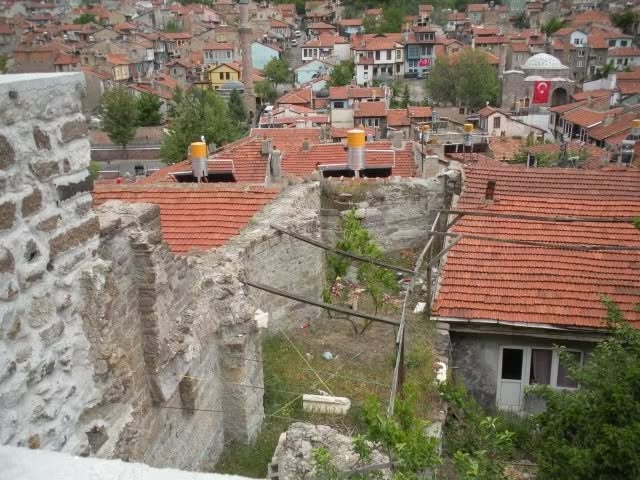
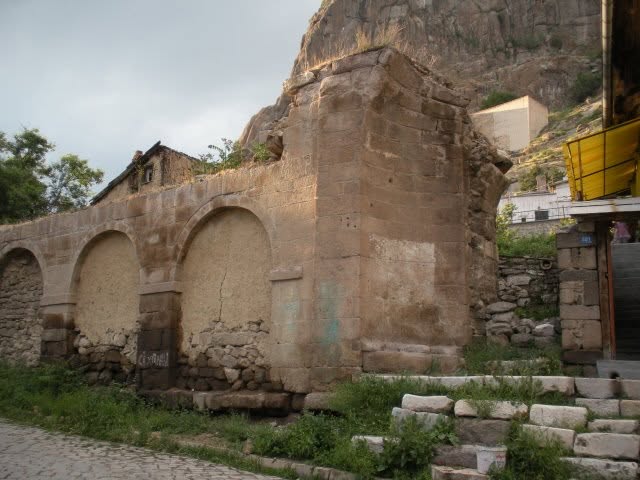
During the Ottoman period, the southern slopes of Afyonkarahisar Castle were also home to the city's Armenian Christian community. The Armenian church, known as Meryem Ana (Holy Mother of God), stood in the neighbourhood beneath the fortress, in an area historically associated with the Armenian population of Afyonkarahisar. Ottoman archival records refer to the church as early as the seventeenth century, documenting both its existence and repair works. In 1670–1671, the building underwent repairs supervised by local authorities and craftsmen, although subsequent records suggest that some of the work was incomplete or faulty. Historical accounts describe a substantial, two-storey structure with spaces for congregational use, accommodation, storage, and other facilities, reflecting its importance within the community.
The church also acquired a connection with the First World War. Following the British landings at Gallipoli, some captured British servicemen, as well as prisoners of war of other nationalities, including French, Australians, and New Zealanders, were eventually imprisoned in Afyonkarahisar, and a group of them was housed in the Armenian church beneath the castle. One of these prisoners, British officer John Still, described the building and his experiences there in his memoir, "A Prisoner in Turkey". The church has since largely disappeared, but its remains have been identified in the Kale Mahallesi neighbourhood, where traces of its foundations and part of the apse survive, incorporated into the walls of adjoining properties. These remnants provide a tangible link not only to the Armenian community that once lived in the shadow of the fortress, but also to the wartime history of the town during the First World War.
Archaeological research
Despite its prominent position and historical significance, Afyonkarahisar Castle has not been the subject of extensive systematic archaeological excavations. Much of what is currently known about its architectural development comes from structural surveys, historical records, conservation studies, and the examination of surviving remains. Particularly useful is the study by Büşra Köker and Seda Şimşek Tolacı (2021), which examines the castle's architectural elements, identifies structures associated with different historical periods, and discusses the alterations made over the centuries. The researchers combine field observations with earlier publications, archival material, restoration documentation, and accounts by travellers to reconstruct the castle's complex architectural history, although the dating of many individual structures remains uncertain.
The oldest identifiable features on the castle rock are associated with Phrygian religious activity. The summit and its approaches preserve rock-cut installations, niches, steps, and other features interpreted as elements of a cult landscape. Among these is a stepped structure traditionally identified as an altar, situated in a relatively flat area near the entrance to the Upper Castle. A carved path and rock-cut steps are among the surviving features in this area. Although these structures are generally associated with Phrygian religious practices, their precise functions and chronological relationships are not fully established.
The castle rock also contains several water cisterns, which were essential for sustaining life within the fortified enclosure, particularly during periods of siege. According to Işık (1991), six cisterns in the Upper Castle were attributed to the Byzantine period, an interpretation subsequently cited by Köker and Şimşek Tolacı. However, some researchers have suggested that certain cisterns may have originated earlier, potentially during the Phrygian period. Their chronology therefore remains a subject of uncertainty, although their importance in the history of the castle's occupation is unquestionable.
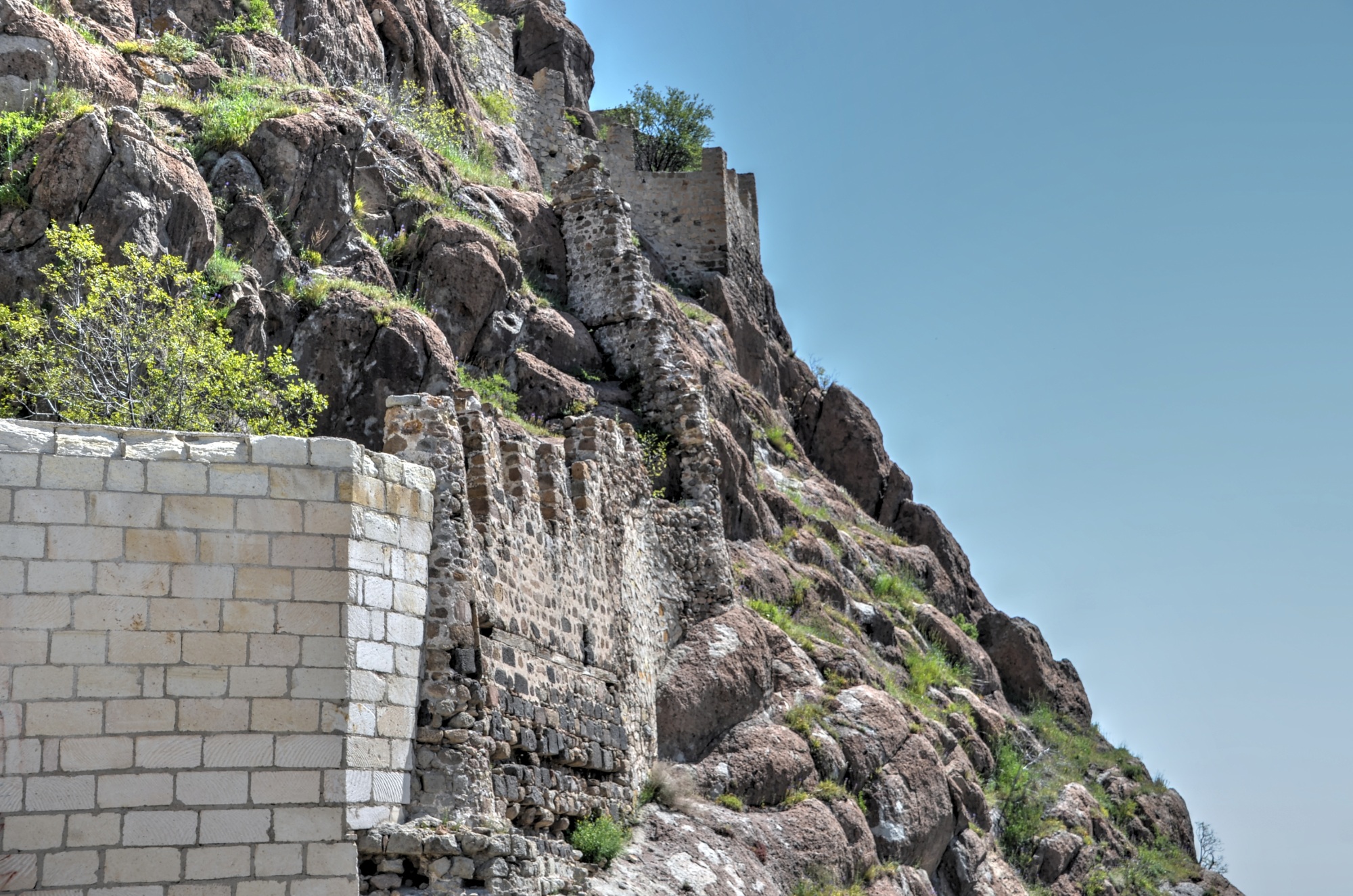
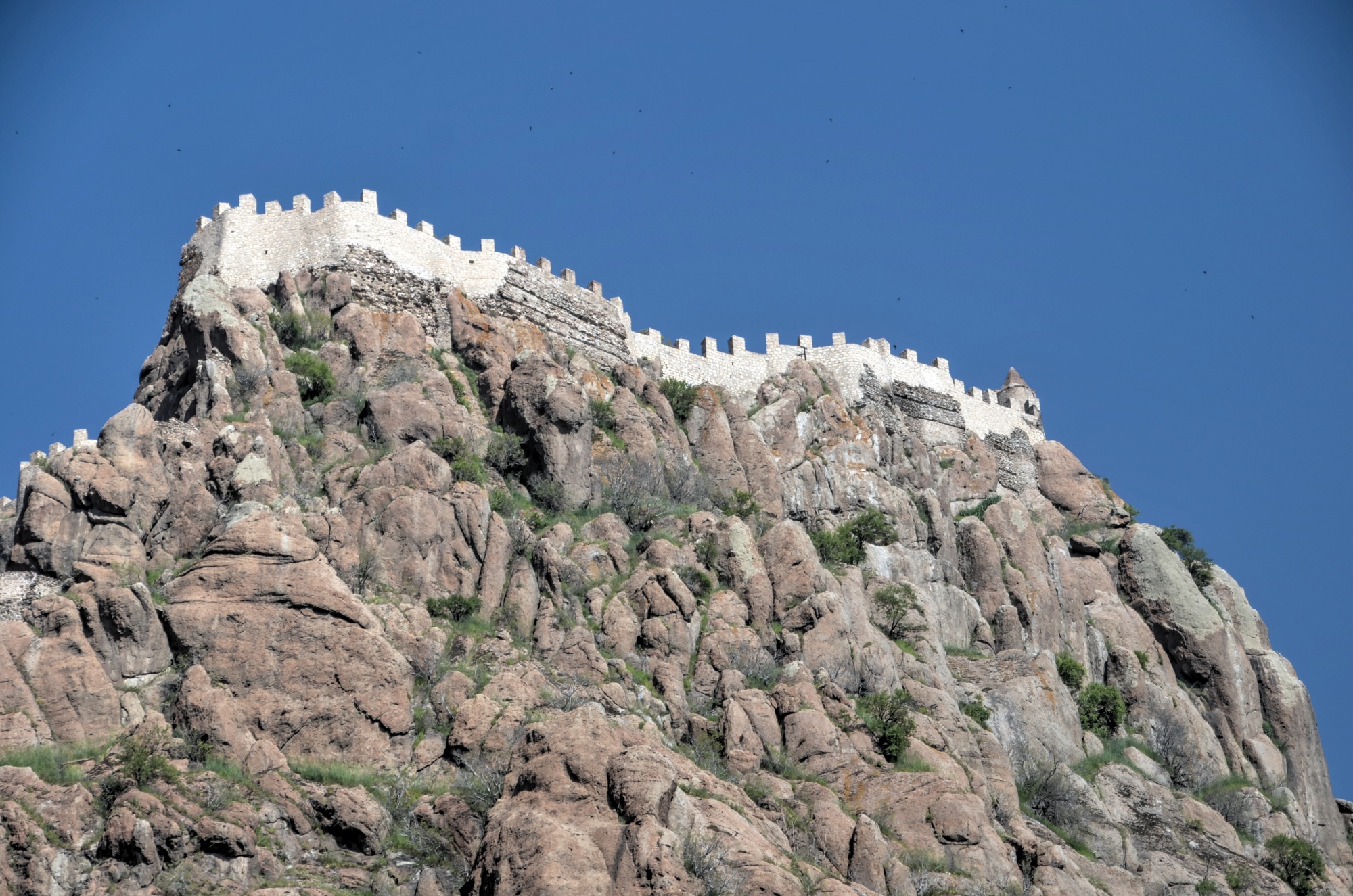
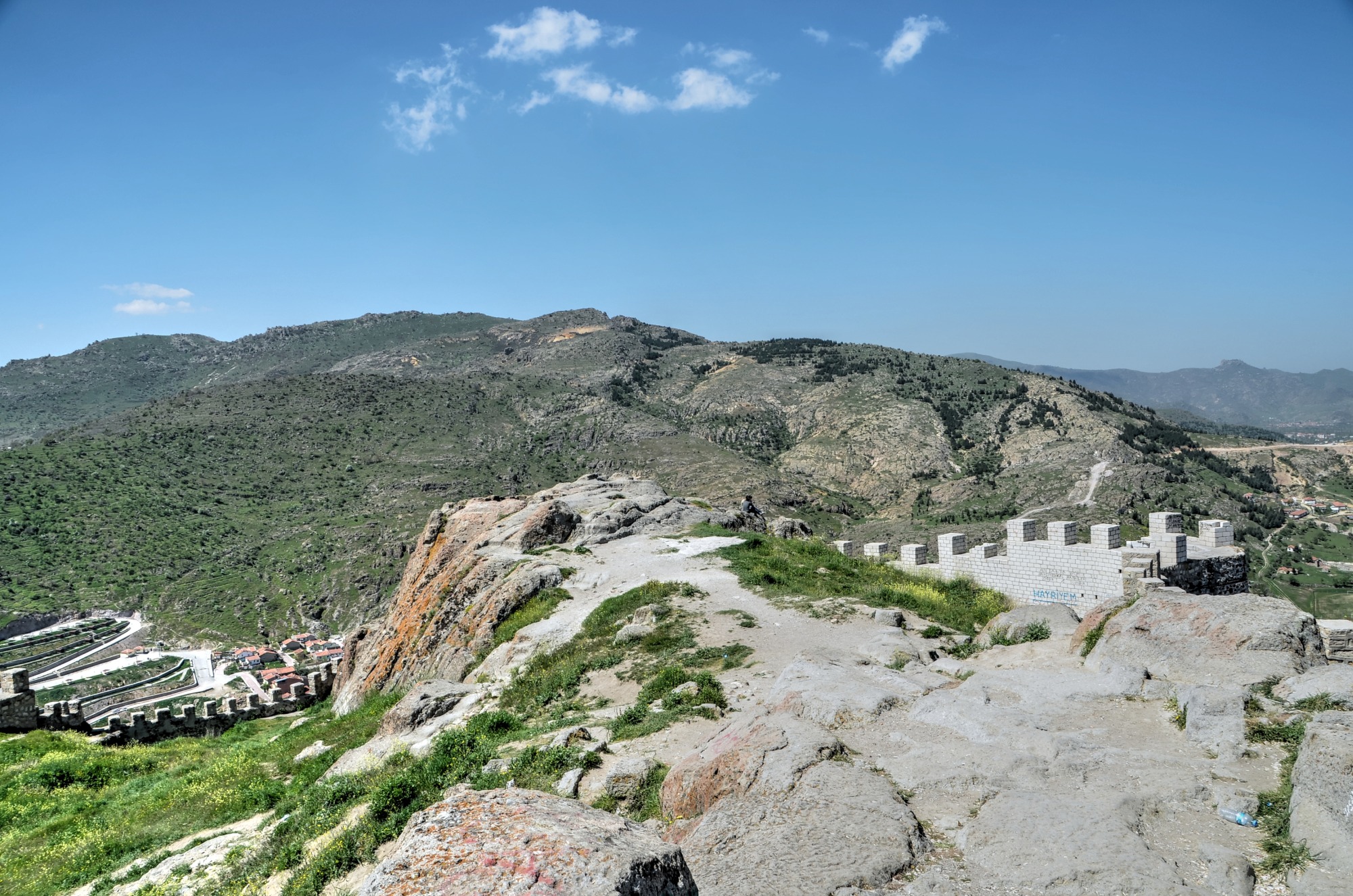
The fortifications themselves reveal a complex history of construction, alteration, and repair. The castle is conventionally divided into Lower, Middle, and Upper sections, each reflecting different aspects of its defensive and residential functions. The Upper Castle occupies the summit of the rock, where its walls follow the natural contours of the terrain, creating an irregular defensive perimeter adapted to the steep and uneven surface. The surviving masonry includes traces of interventions from different periods, although distinguishing the original construction phases from later repairs is often difficult. The Middle Castle preserves additional traces of fortifications, gates, and defensive structures, but these have been particularly affected by later alterations and restoration works. The Lower Castle formed part of the wider defensive and residential area around the rock, although its architectural development is likewise difficult to reconstruct in detail.
Evidence of Byzantine occupation is also found among the remains on the summit. Behind the rock-cut cult area traditionally identified as the Phrygian temple, foundations interpreted as belonging to a Byzantine church have been reported. However, the building has not been securely identified, and its precise date and relationship to other structures on the summit remain unclear. The church foundations should not automatically be associated with the church dedicated to Archangel Michael mentioned in a Byzantine inscription commemorating its renovation under Bishop Niketas, probably during the reign of Constantine VII (945–959). That inscription provides evidence for the existence of a Christian ecclesiastical institution in Akroinos, but its original location has not been conclusively established.
The castle underwent substantial architectural development during the Seljuk period, particularly in the reign of Alaeddin Keykubad I (1220–1237). Historical accounts associate the construction or reconstruction of major structures within the Upper Castle, including a palace and a mosque, with the year 1231. Their approximate locations have traditionally been inferred from historical descriptions and the arrangement of the surviving architectural remains, but neither building has been conclusively identified archaeologically. The castle's successive occupation by the Seljuks, Sahibataoğulları, Germiyanids, and Ottomans further contributed to its architectural complexity, although the attribution of particular surviving structures to these dynasties requires caution.
The condition of the castle today also reflects centuries of maintenance, neglect, and modern conservation interventions. Restoration works, including those undertaken between 1999 and 2002, altered parts of the surviving masonry, and some earlier architectural traces were reportedly lost or obscured. The castle has been protected as a First-Degree Archaeological and Natural Site since a decision issued on 12 February 1988. More recent conservation discussions have also considered its wider landscape setting and the potential effects of modern infrastructure, particularly in connection with the cable-car project. The 2026 UNESCO World Heritage Centre and ICOMOS advisory mission report, although primarily concerned with the setting and protection of Afyonkarahisar Ulu Mosque, also discusses the castle as an important historical and archaeological feature of the city's landscape.
A major modern infrastructure project has also affected the fortress and its surrounding landscape. A cable-car system connecting the city with Afyonkarahisar Castle was planned as part of a broader development involving visitor facilities, viewing terraces, walkways, and parking. The project, whose selected route was adopted in 2016, envisaged a lower station at Erdal Akar Park and an upper station within the castle. Archaeological test excavations carried out at three proposed locations for the cable-car infrastructure uncovered rubble-stone wall remains at two sites, while bedrock was encountered at the planned upper-station location.
Construction subsequently progressed at the lower station and involved substantial excavation and landscape modification, as well as works at the summit, before the project was halted in 2023 amid concerns about its impact on the setting of Afyonkarahisar Ulu Mosque, part of the UNESCO World Heritage property called Wooden Hypostyle Mosques of Medieval Anatolia. A joint World Heritage Centre/ICOMOS Advisory Mission in February 2026 examined the project, its completed and unfinished infrastructure, and possible alternative routes. Although the mission's assessment focused principally on the mosque and its setting rather than on the fortress's archaeological fabric, its report provides important documentation of the extent to which the proposed cable-car scheme has already altered parts of the castle's surrounding landscape and summit.
Sightseeing
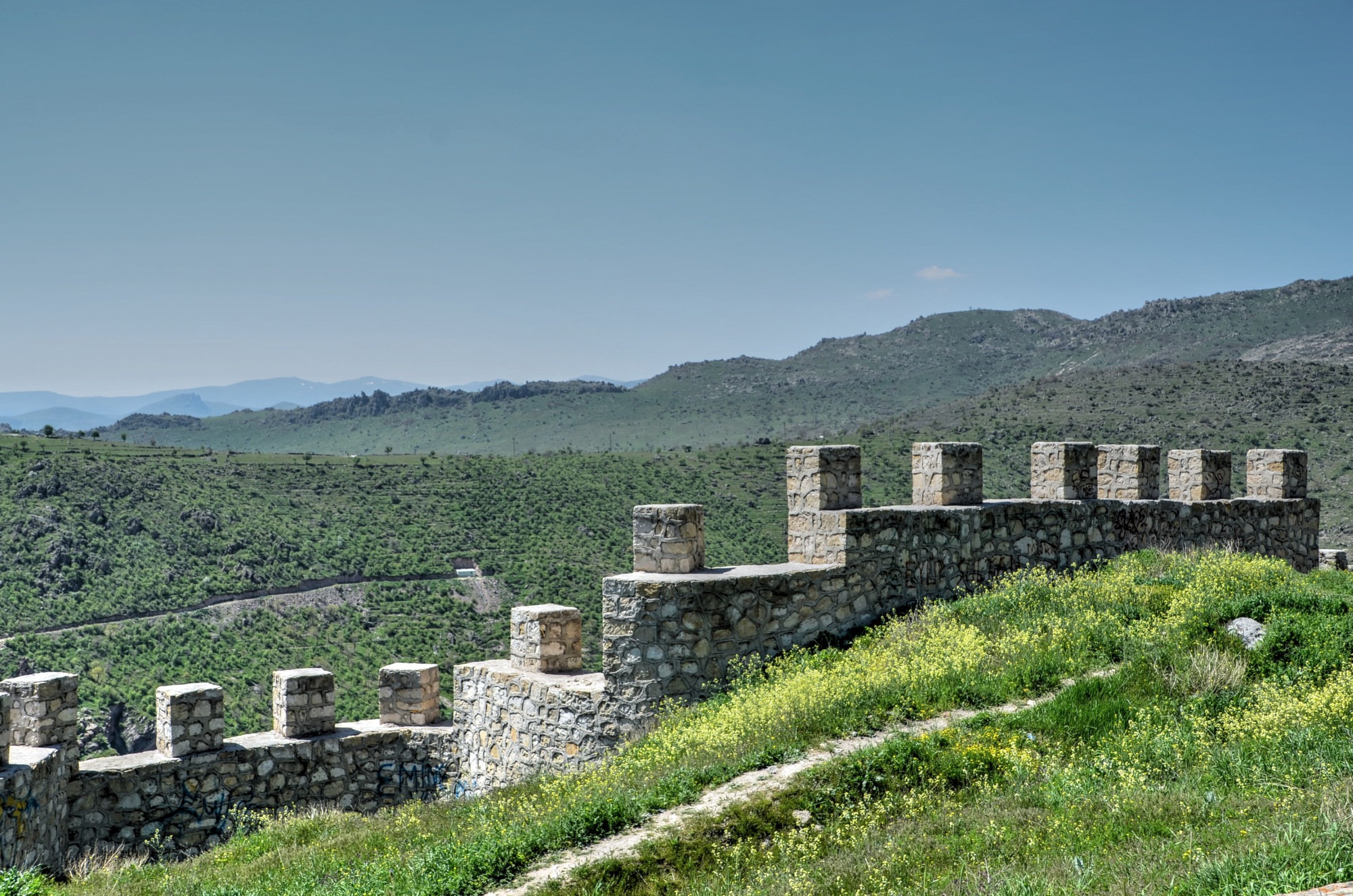
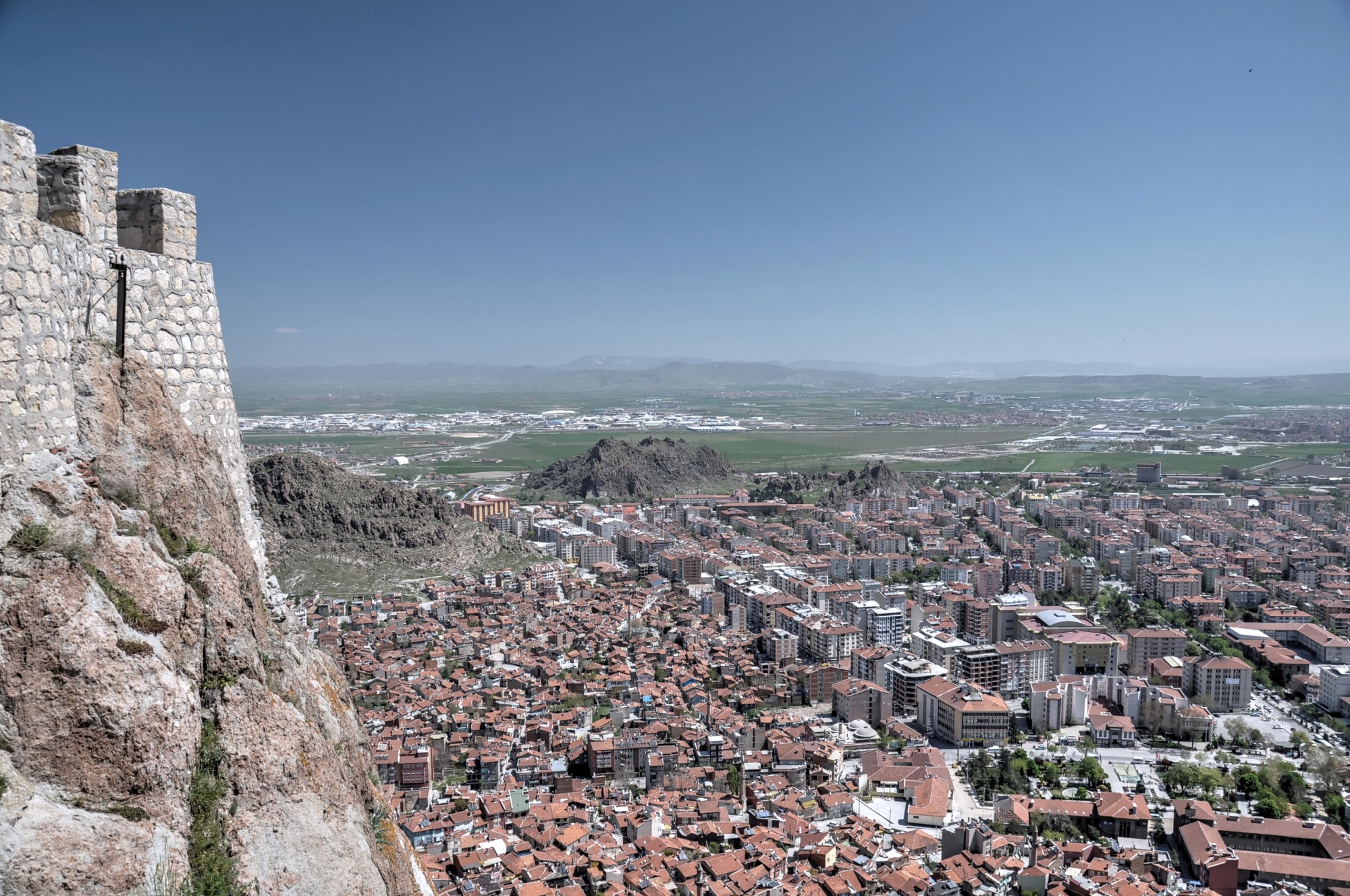
Afyonkarahisar Castle occupies a steep volcanic rock rising prominently above the modern town. The fortress was traditionally divided into three sections – the Lower, Middle, and Upper Castle – which together formed a complex of defensive, residential, storage, and administrative structures adapted to the natural contours of the rock. Although the boundaries between these sections are not always readily apparent today, this division provides a useful framework for exploring the site, beginning at the lower slopes and gradually ascending towards the summit.
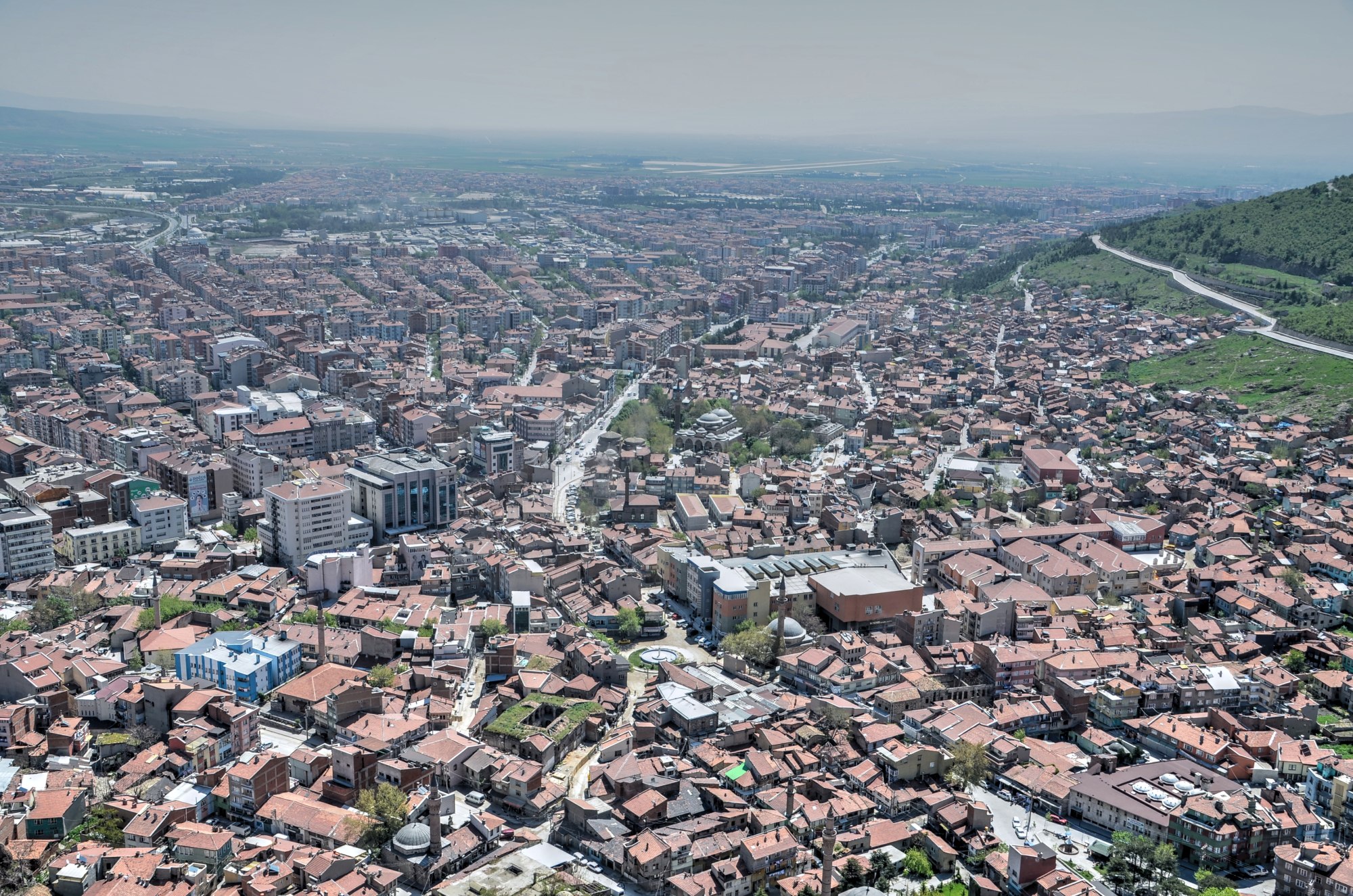
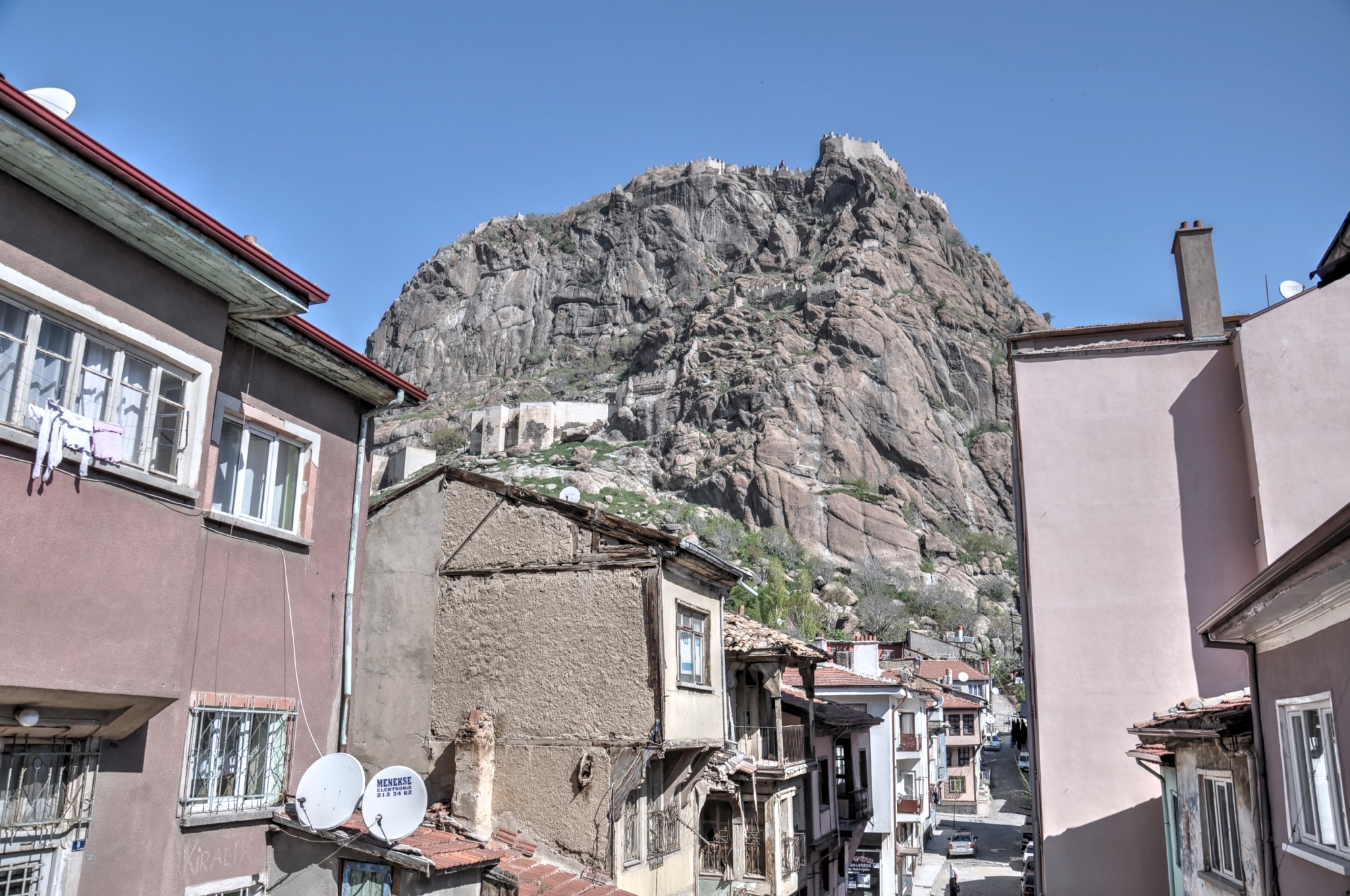
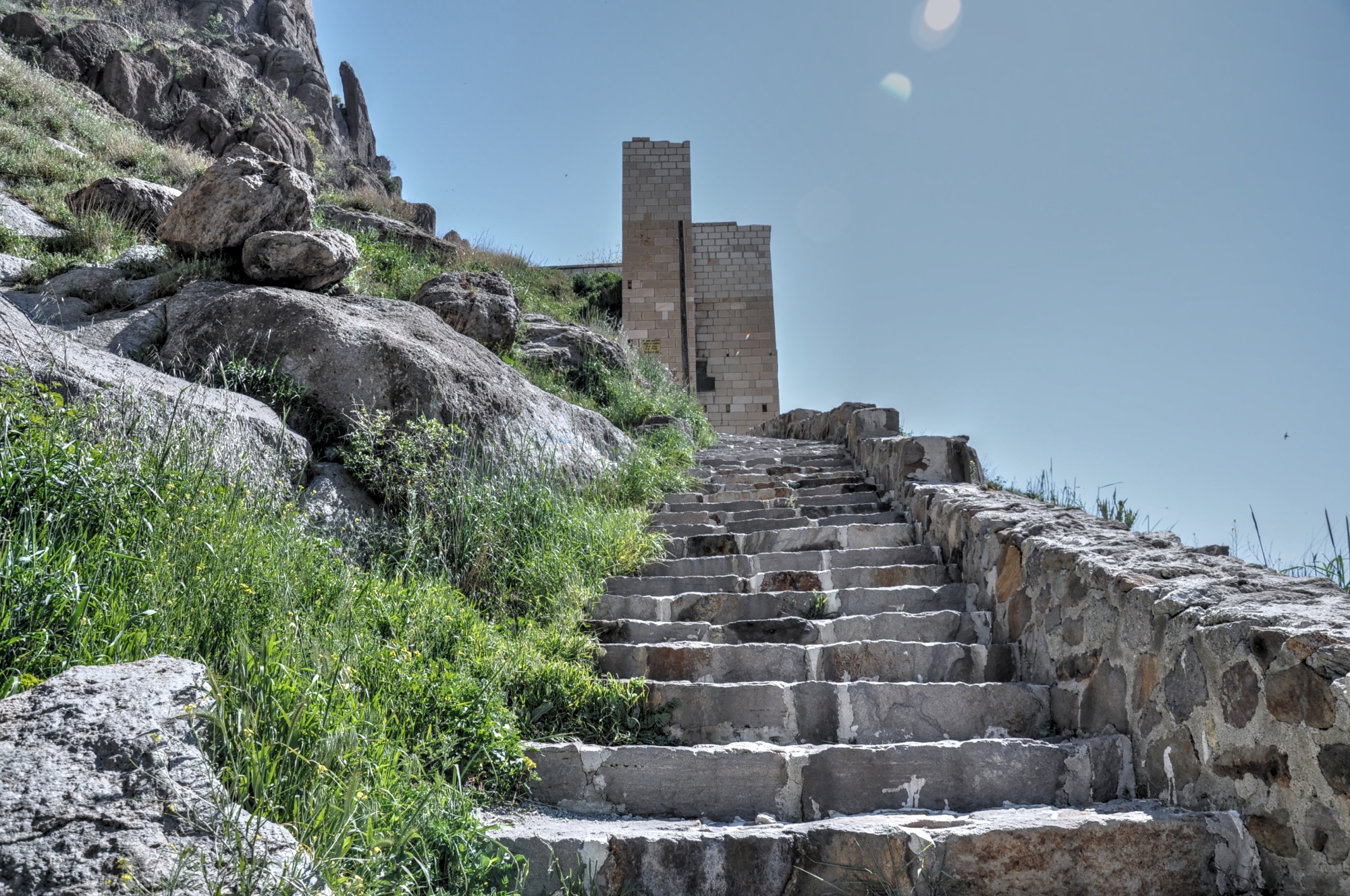
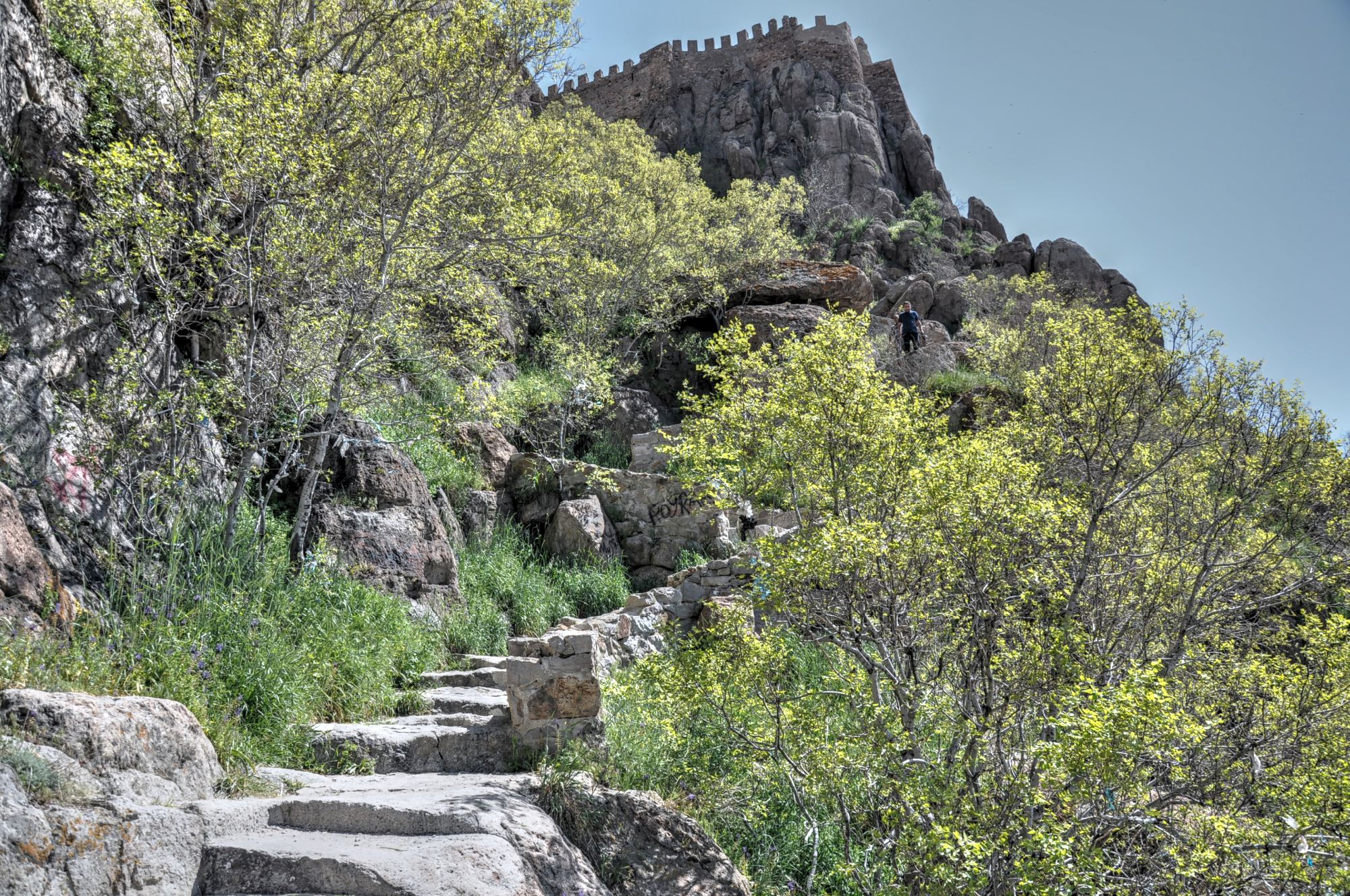
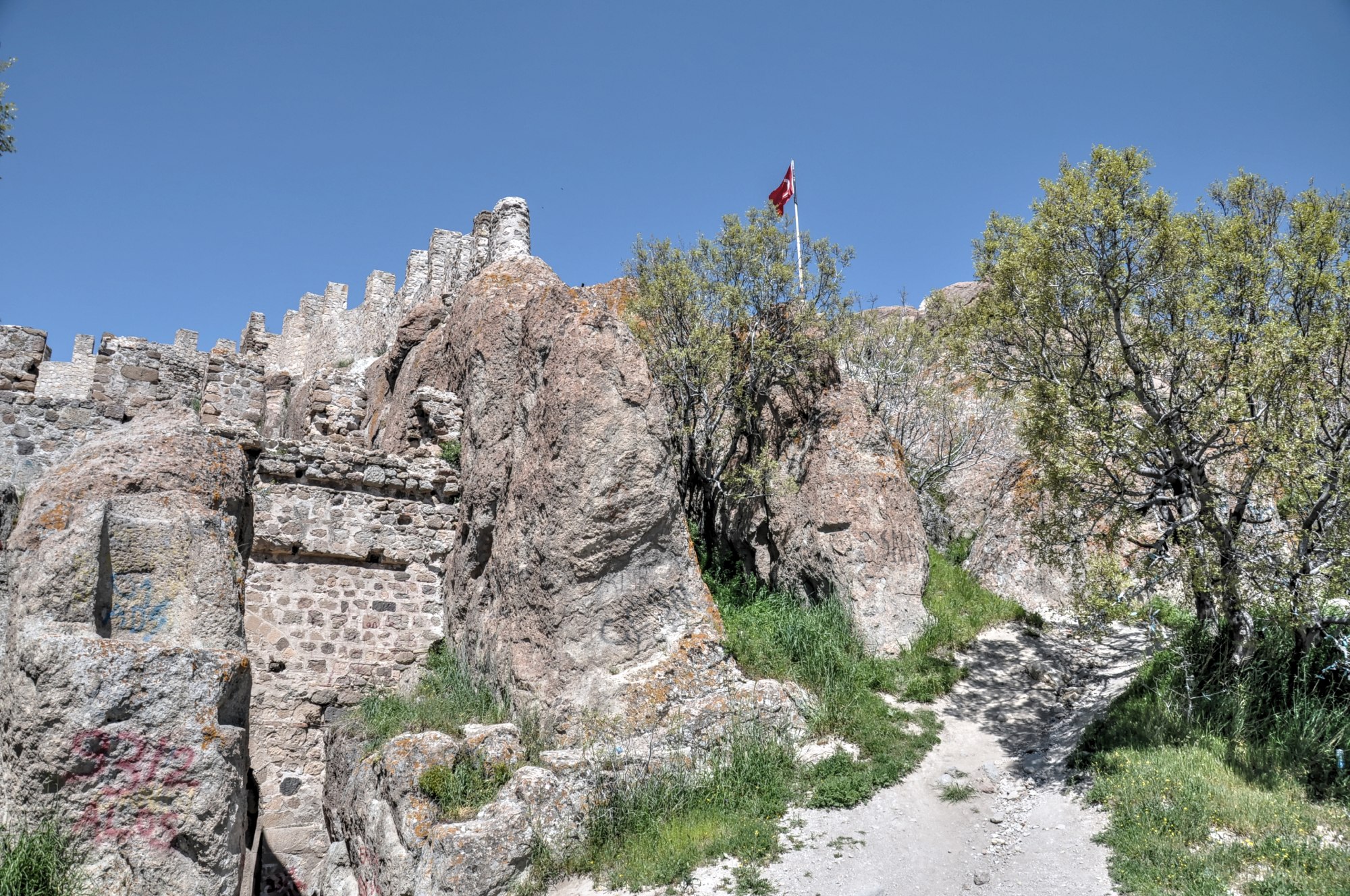
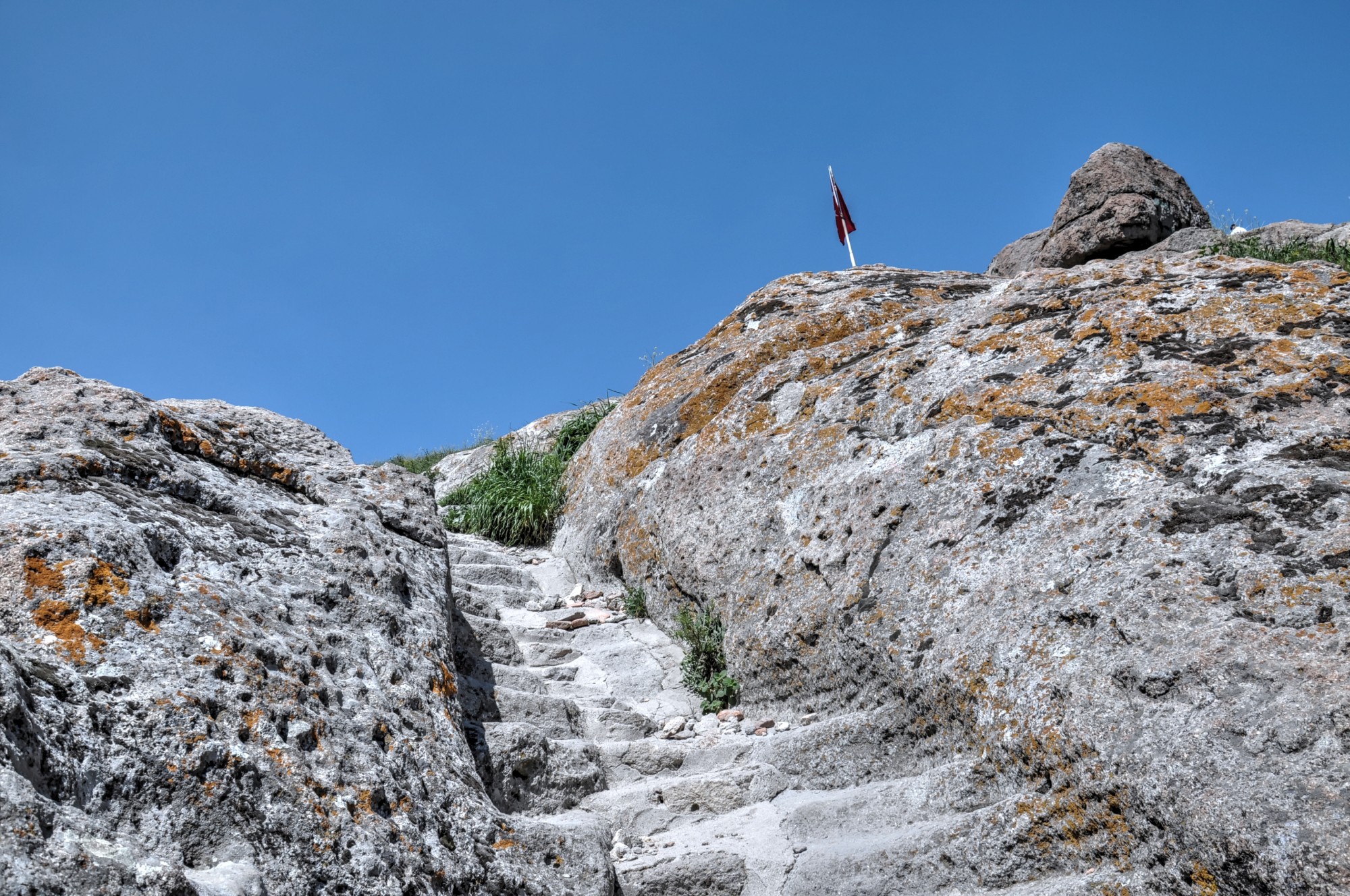
The approach to the castle starts in the historic neighbourhoods at the foot of the rock, where the narrow streets and traditional houses form part of the wider historic setting of the fortress. The climb involves ascending hundreds of steps along a steep and sometimes uneven path, making it a strenuous undertaking, particularly in hot weather. There is limited shade and few places to rest comfortably, so visitors should allow sufficient time, wear sturdy footwear, and carry water. The ascent is not particularly suitable for people with mobility difficulties, but the effort is rewarded by the opportunity to explore the different levels of the fortress and enjoy increasingly expansive views over the city.
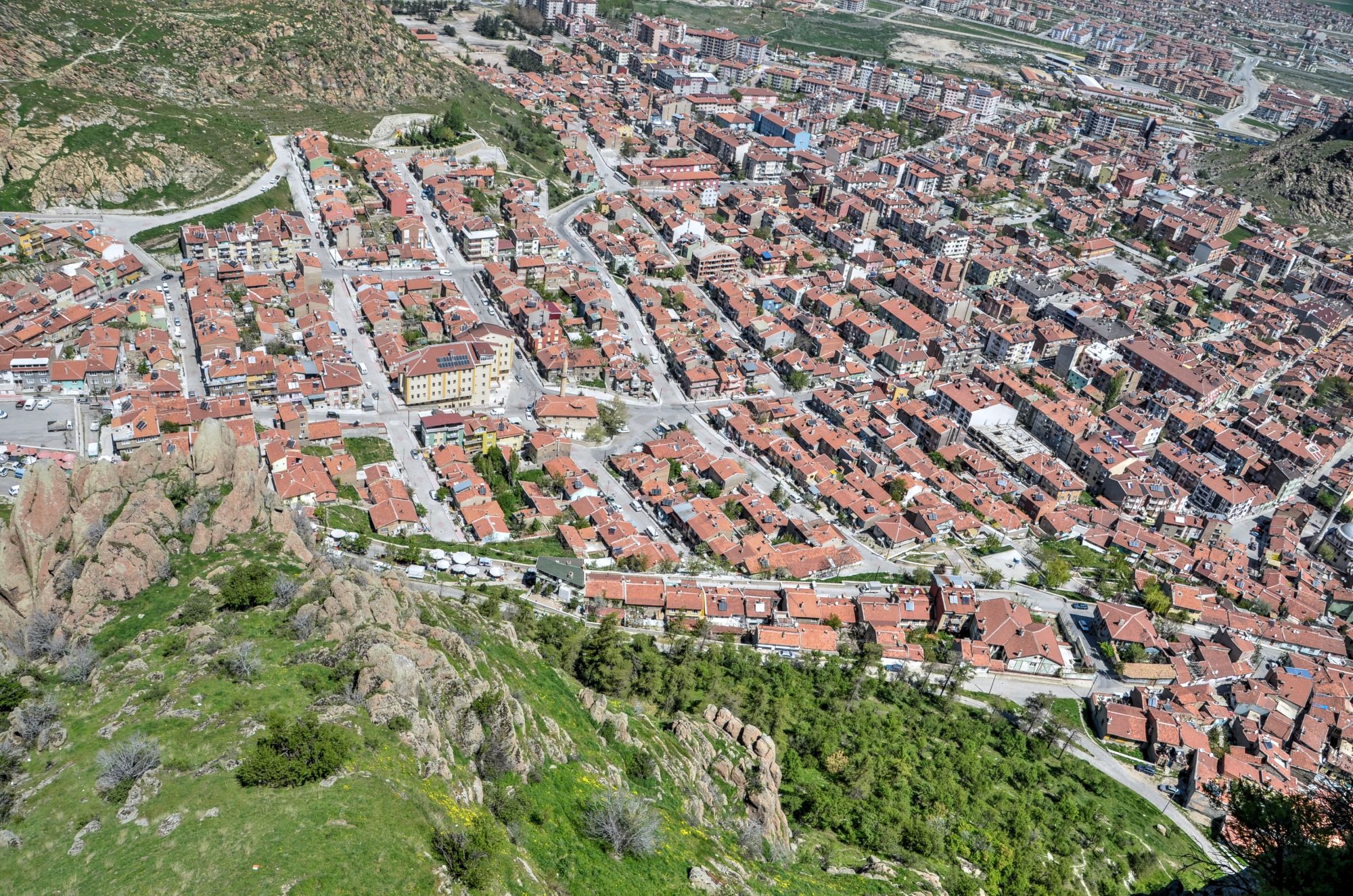
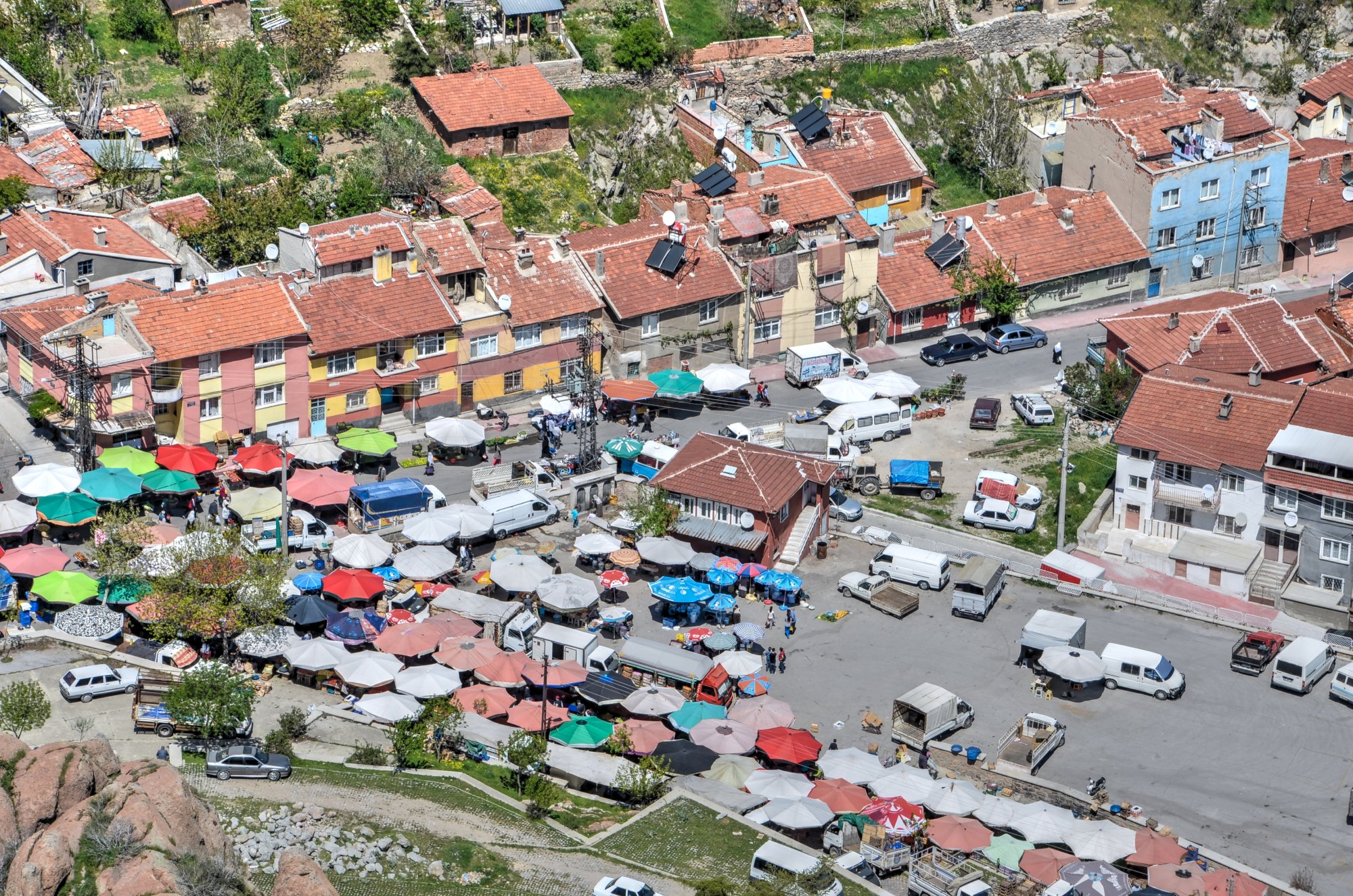
The Lower Castle occupied the southern and western foothills of the rocky outcrop and formed part of the wider fortified complex, which accommodated structures serving various practical and administrative purposes. Although relatively little of its original architecture is readily identifiable today, exploring the lower approaches helps convey the scale of the fortress and its relationship with the settlement below. The streets and buildings at the foot of the rock also provide a sense of how closely the town developed around this natural defensive landmark.
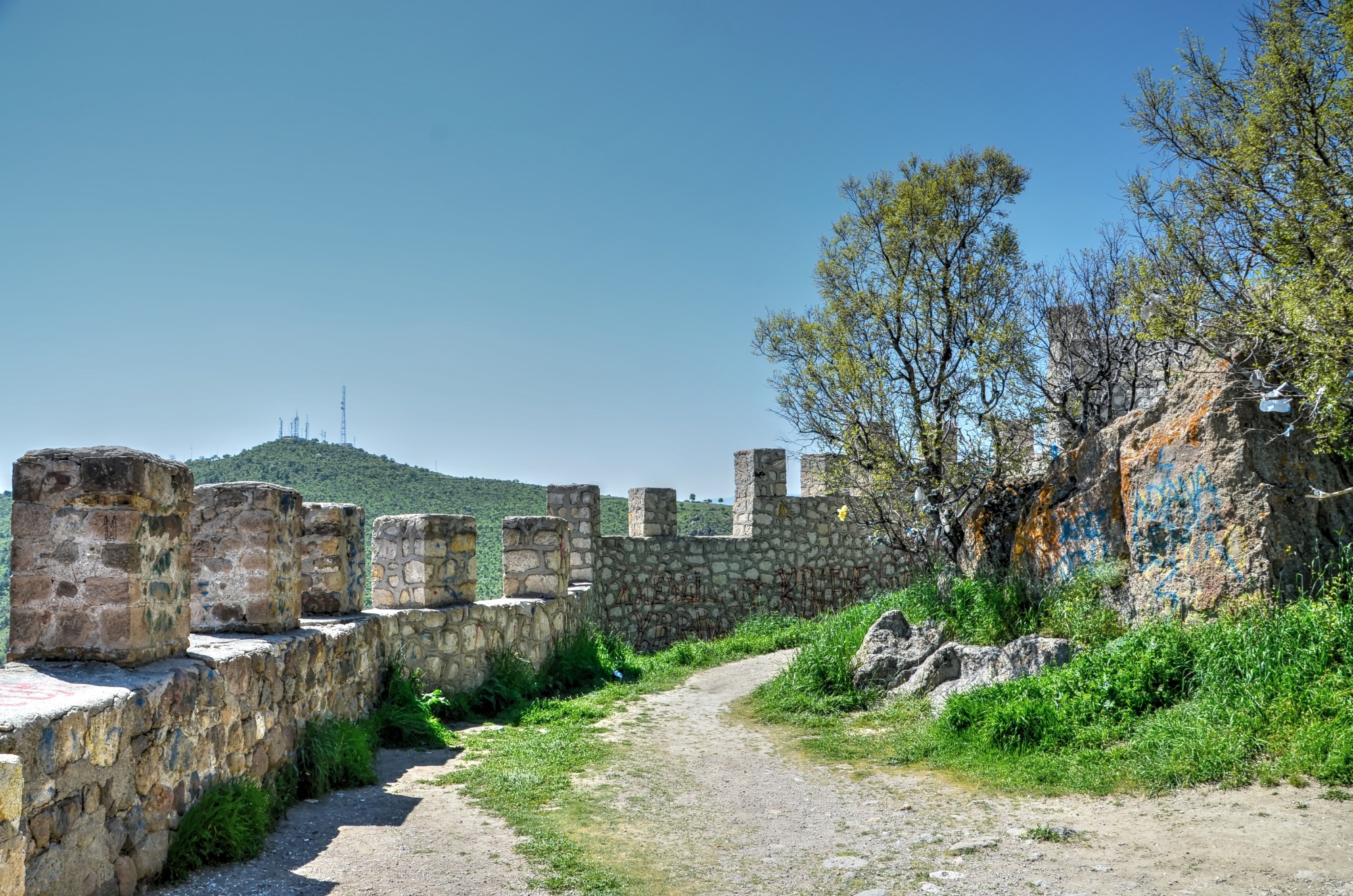
Ascending further leads towards the Middle Castle, where remnants and traces of the fortifications and associated structures can still be encountered. Historical descriptions refer to a dungeon and a small crenellated bastion in this section, although the identification and condition of individual features have been affected by later alterations and restoration works. The Middle Castle formed an important part of the defensive and practical organisation of the fortress, linking the lower approaches with the more heavily fortified summit.
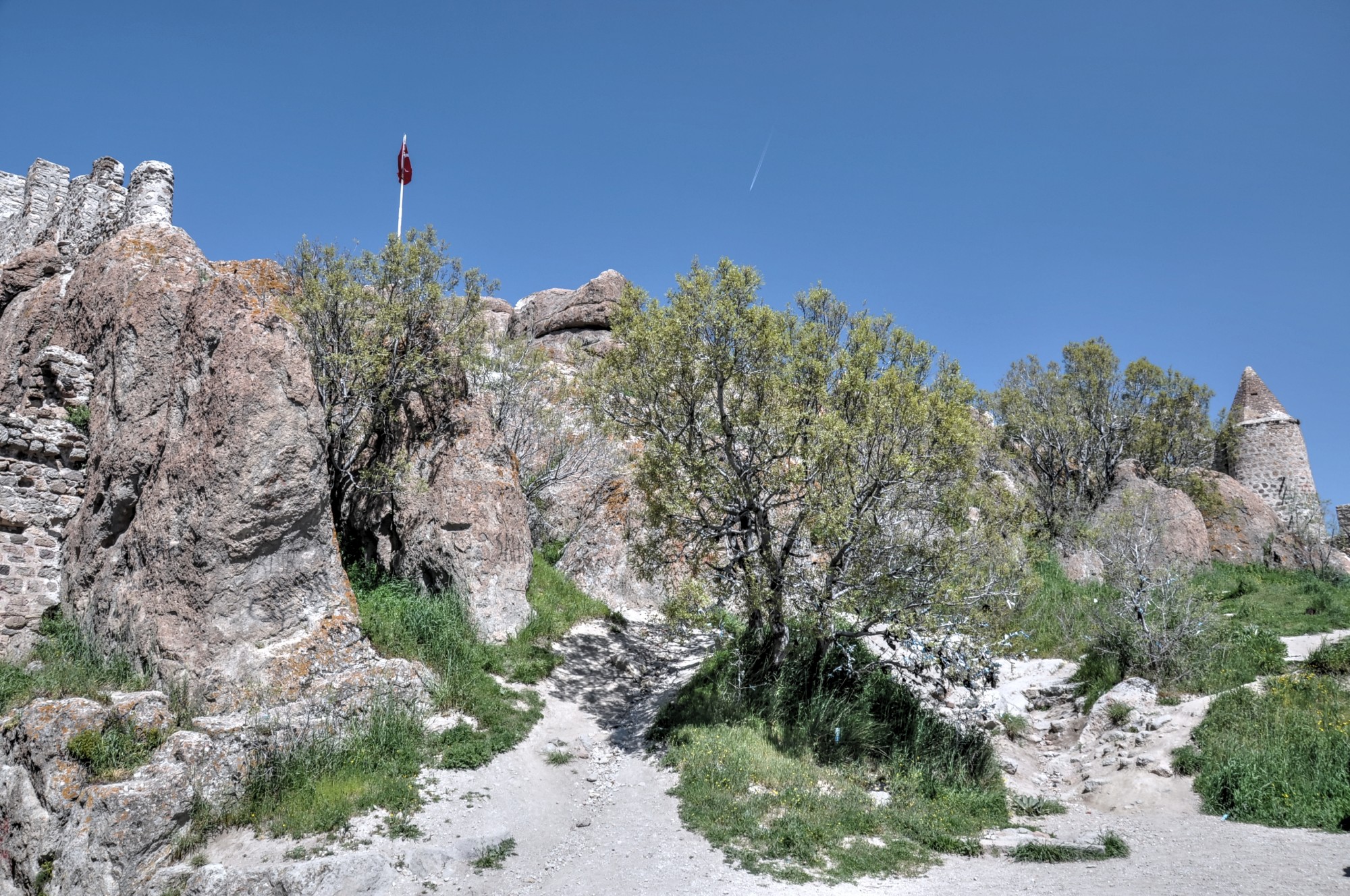
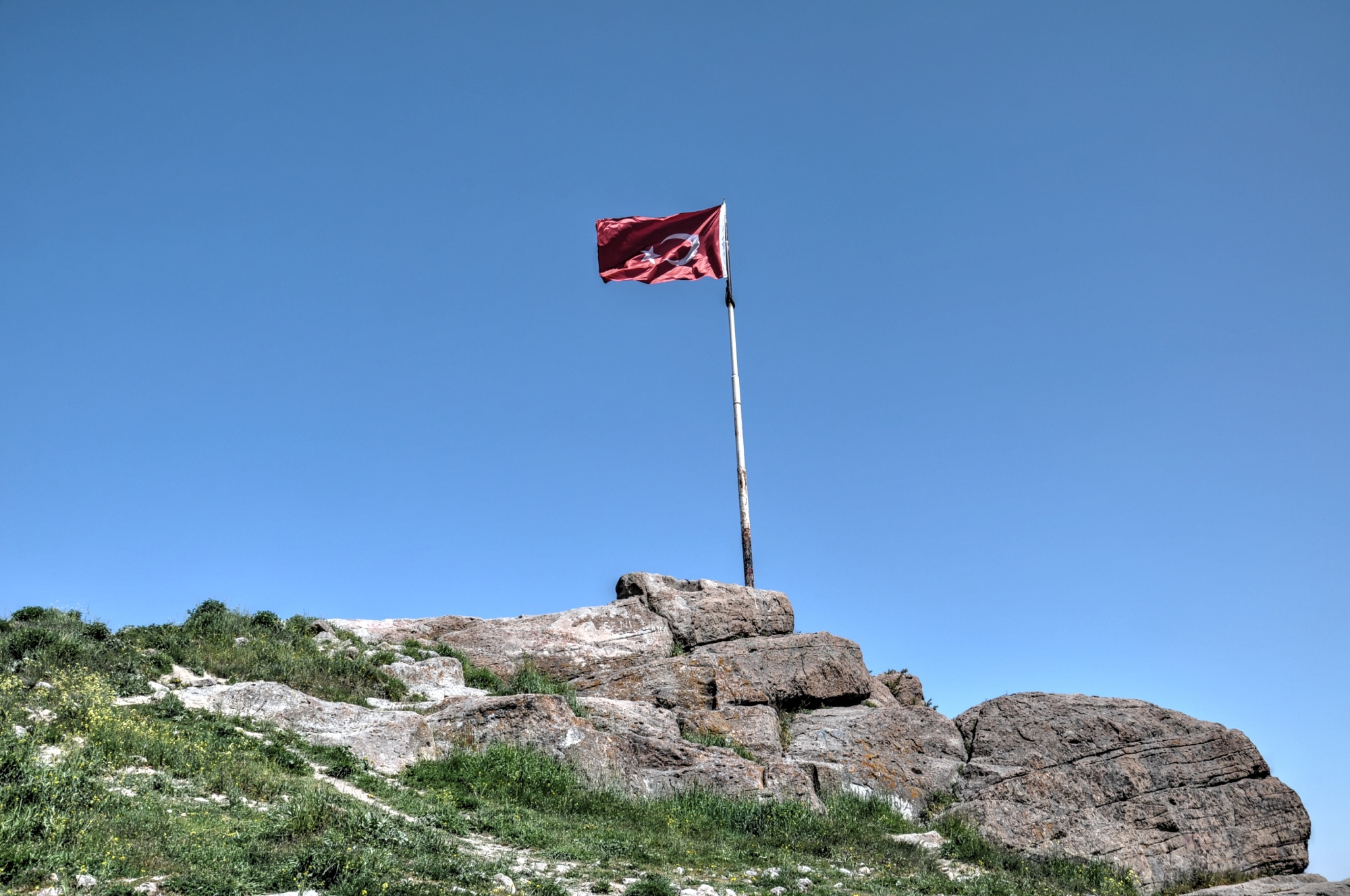
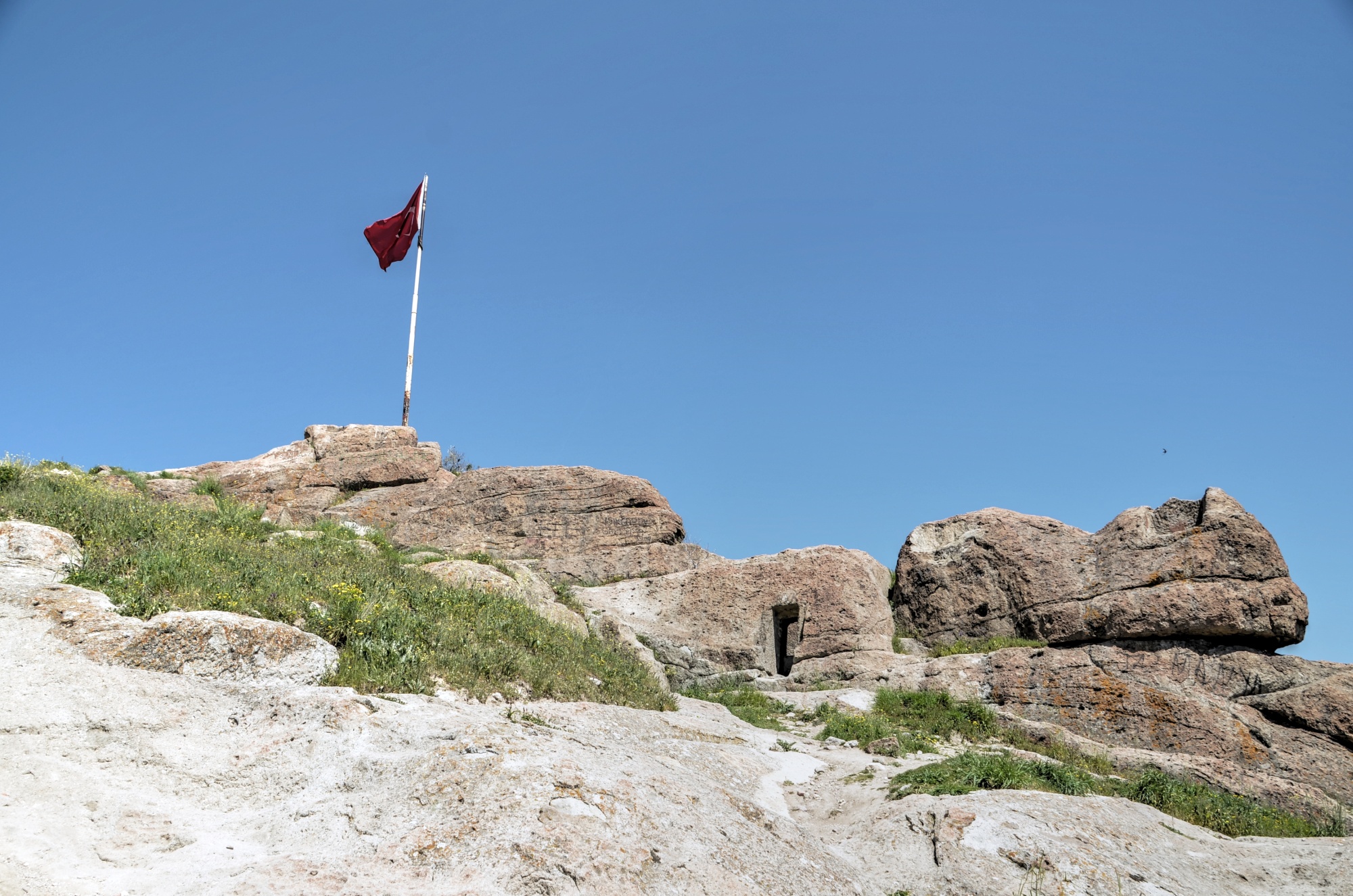
The Upper Castle, located at the summit, is the most historically significant part of the complex and contains some of the oldest traces of occupation. Among the features associated with Phrygian religious activity are a rock-cut cult area, niches, offering pits, and a stepped altar connected with the worship of the Mother Goddess Kybele (Matar). These features demonstrate how the Phrygians incorporated the natural rock into their religious practices, using its surfaces and recesses to create sacred spaces rather than constructing conventional freestanding temples. The cult area is particularly interesting because it preserves evidence of ritual activities carried out on the summit long before the fortress assumed its later defensive role. The Turkish flag flying above the summit is a prominent modern landmark and can be seen from many parts of the town.
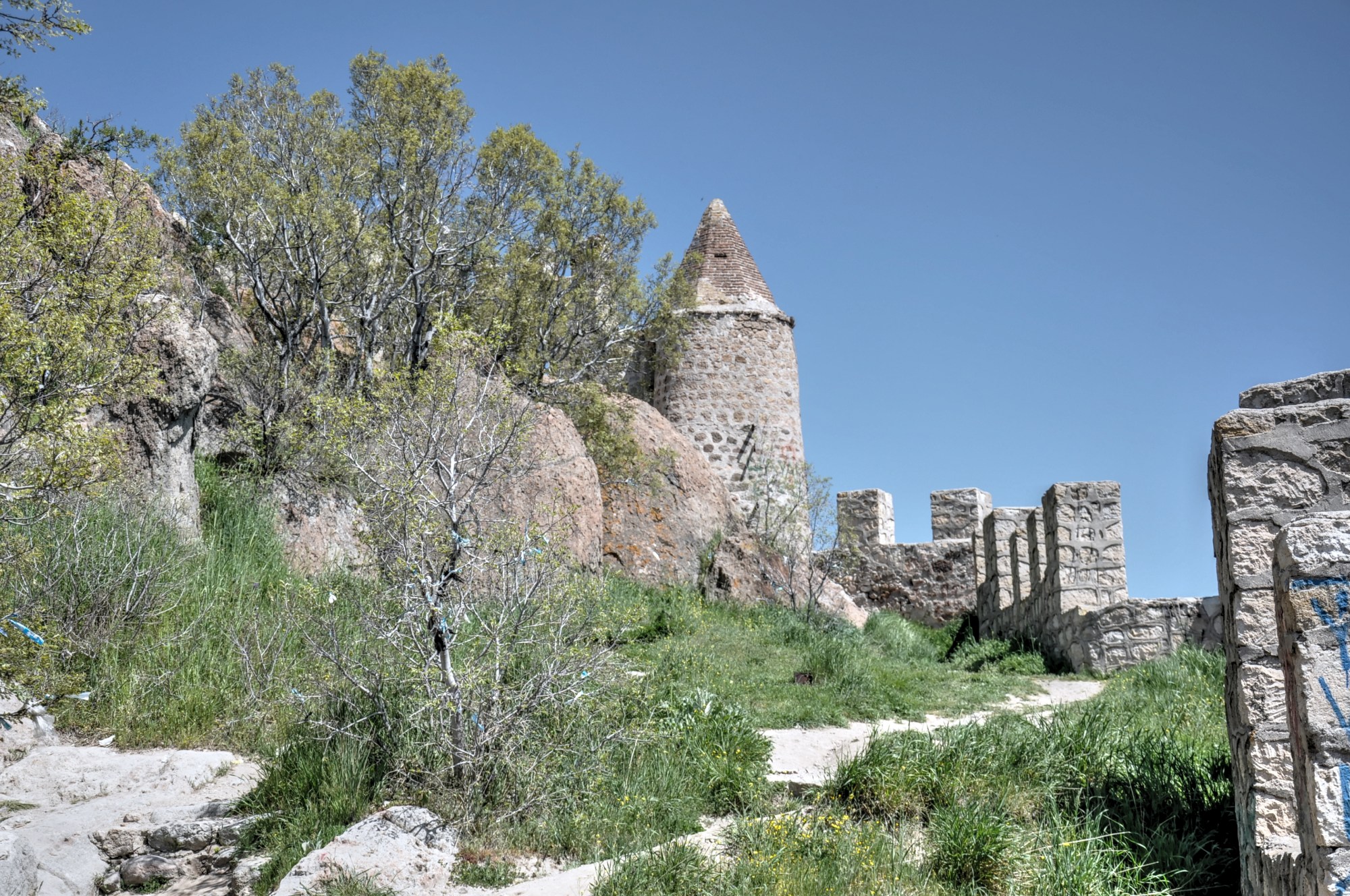
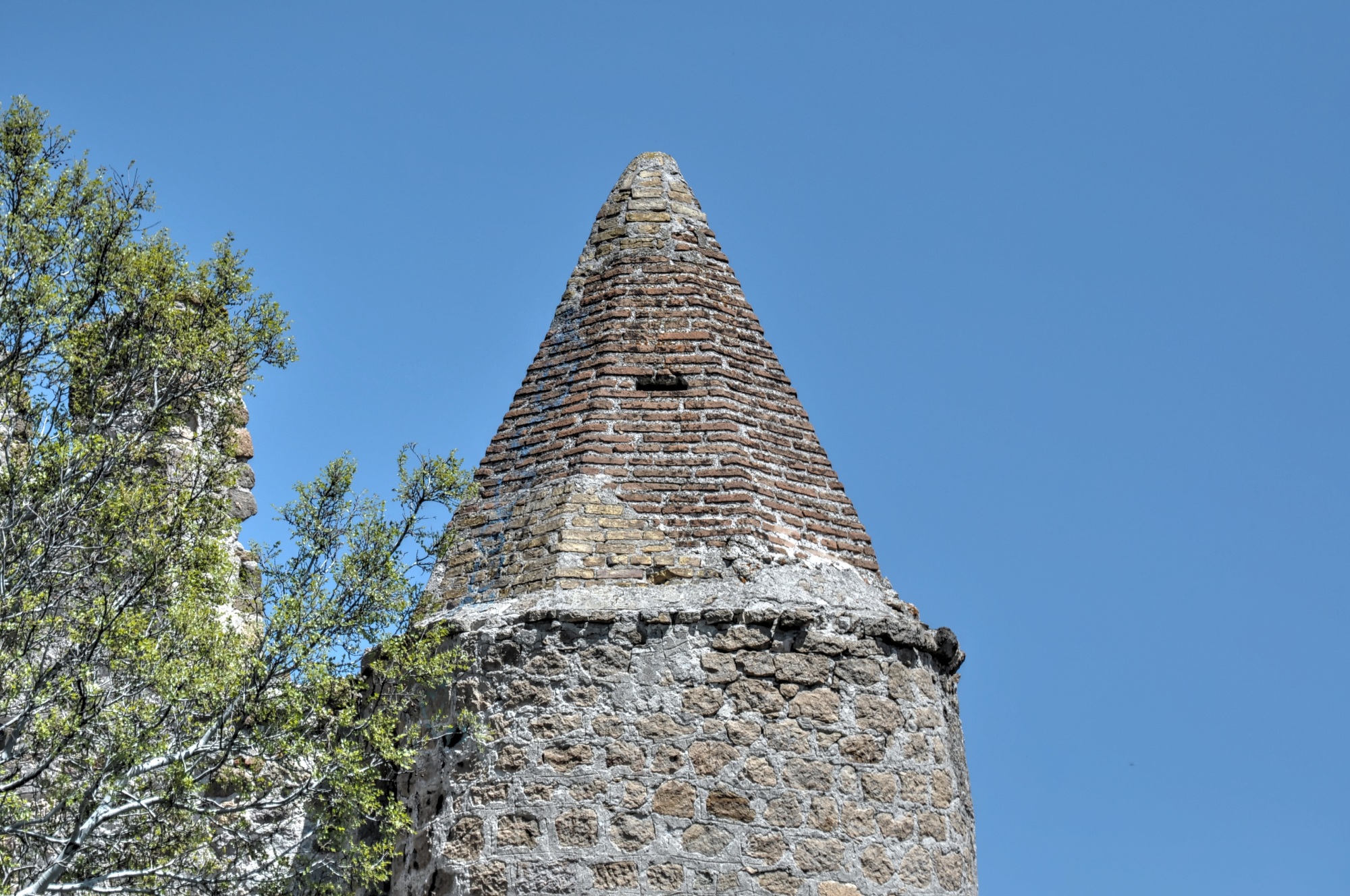
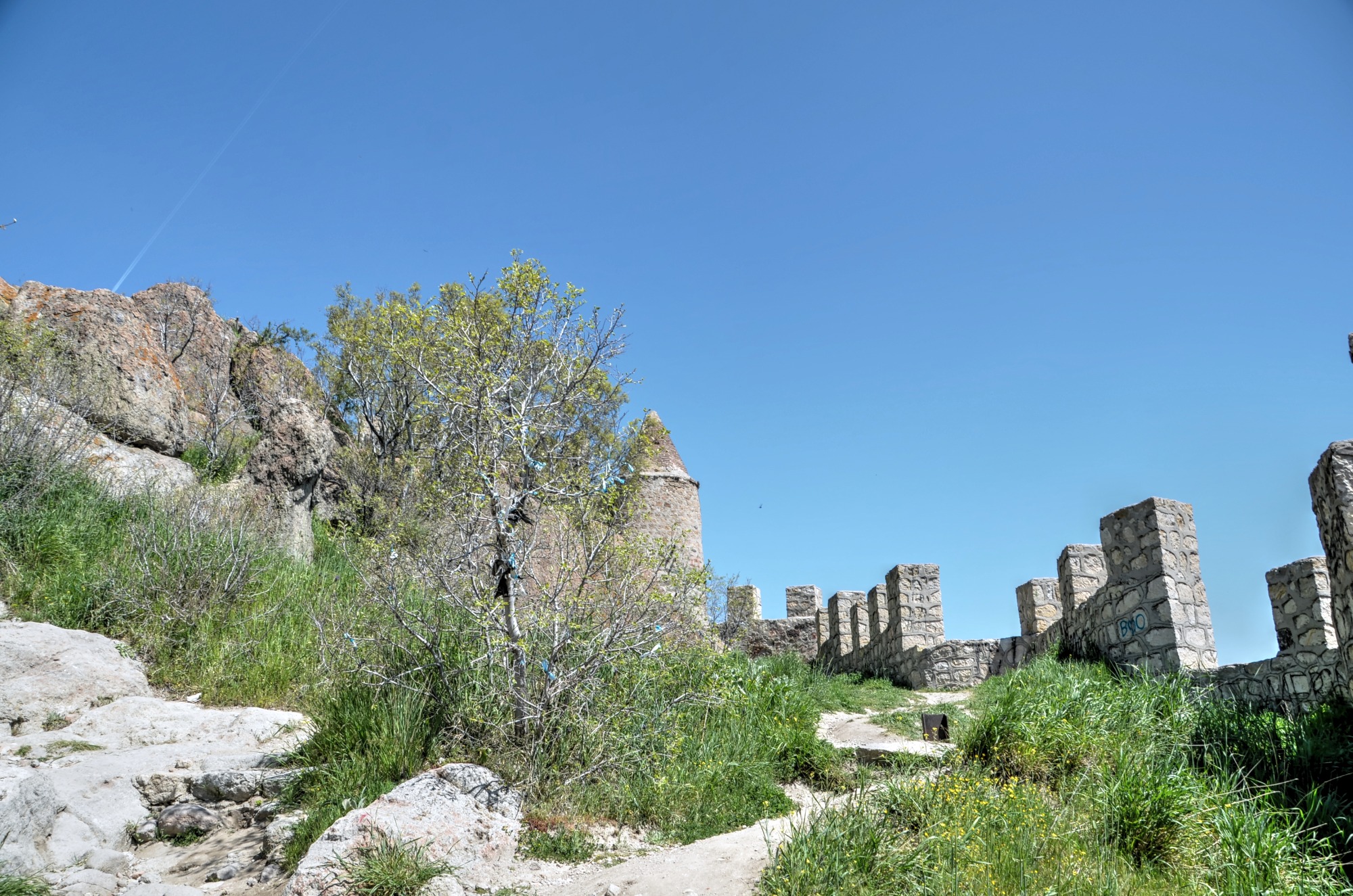
The Maiden's Tower (Kız Kulesi) stands at the northeastern edge of the Upper Castle, on the outermost point facing the city. It is a small, round observation tower, probably originally covered by a masonry conical dome, although its present appearance reflects subsequent modifications. The tower has also become an important part of Afyonkarahisar's local folklore. According to a legend, the daughter of a Byzantine ruler fell in love with a Turkish warrior named Beyböğrek, who had been captured and imprisoned in the castle. The young woman helped him escape by drugging the guards, opening the dungeon, and lowering him from the tower with a rope extended by her own hair. Although this story belongs to folklore rather than documented history, it has contributed to the tower's cultural significance. For generations, the Maiden's Tower has also been visited by young women hoping to find a husband, who traditionally called out verses asking for their fortunes in marriage to be opened. The tower thus remains not only a distinctive architectural feature of the Upper Castle but also a place associated with local traditions, legends, and popular beliefs.
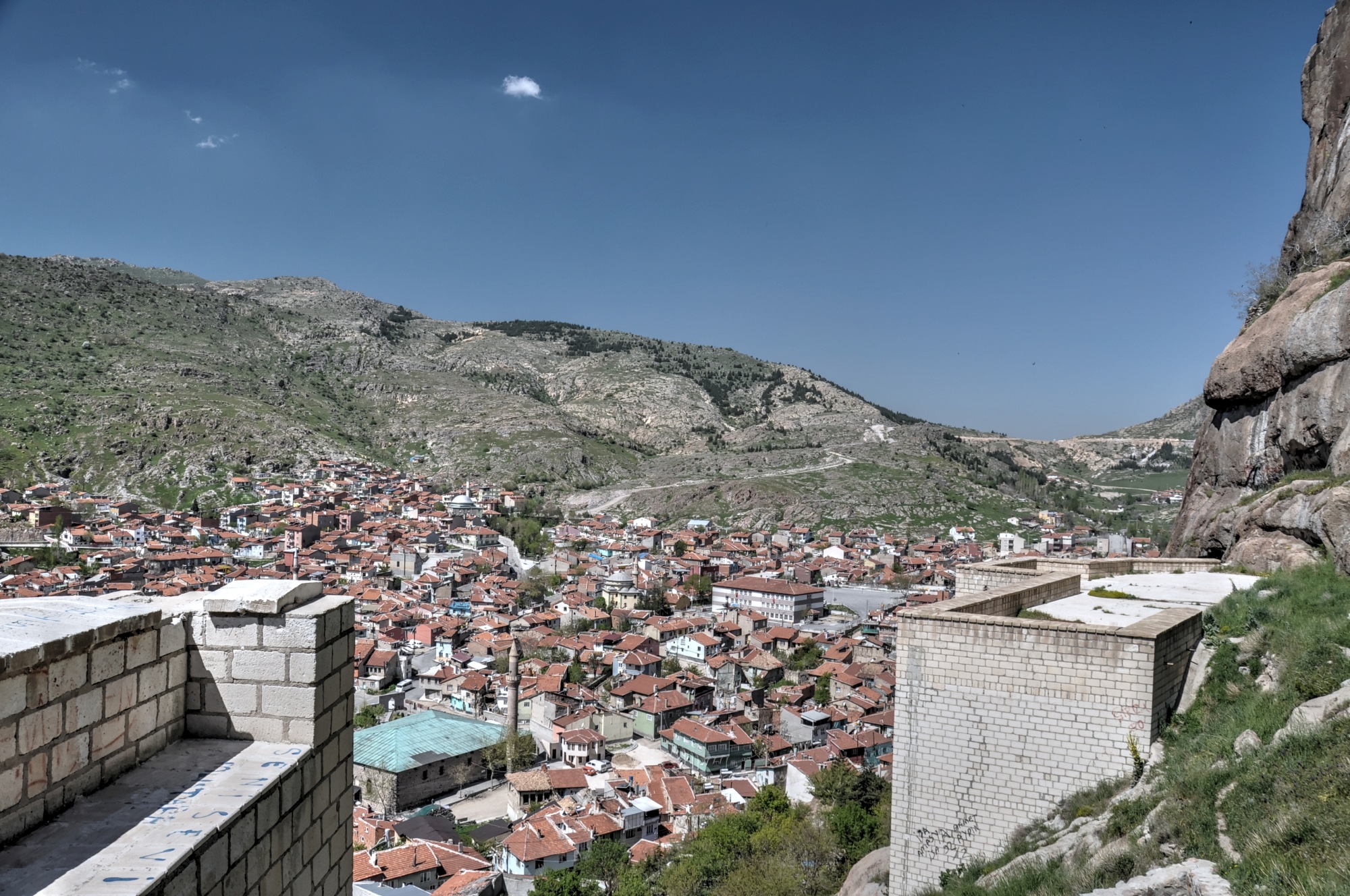
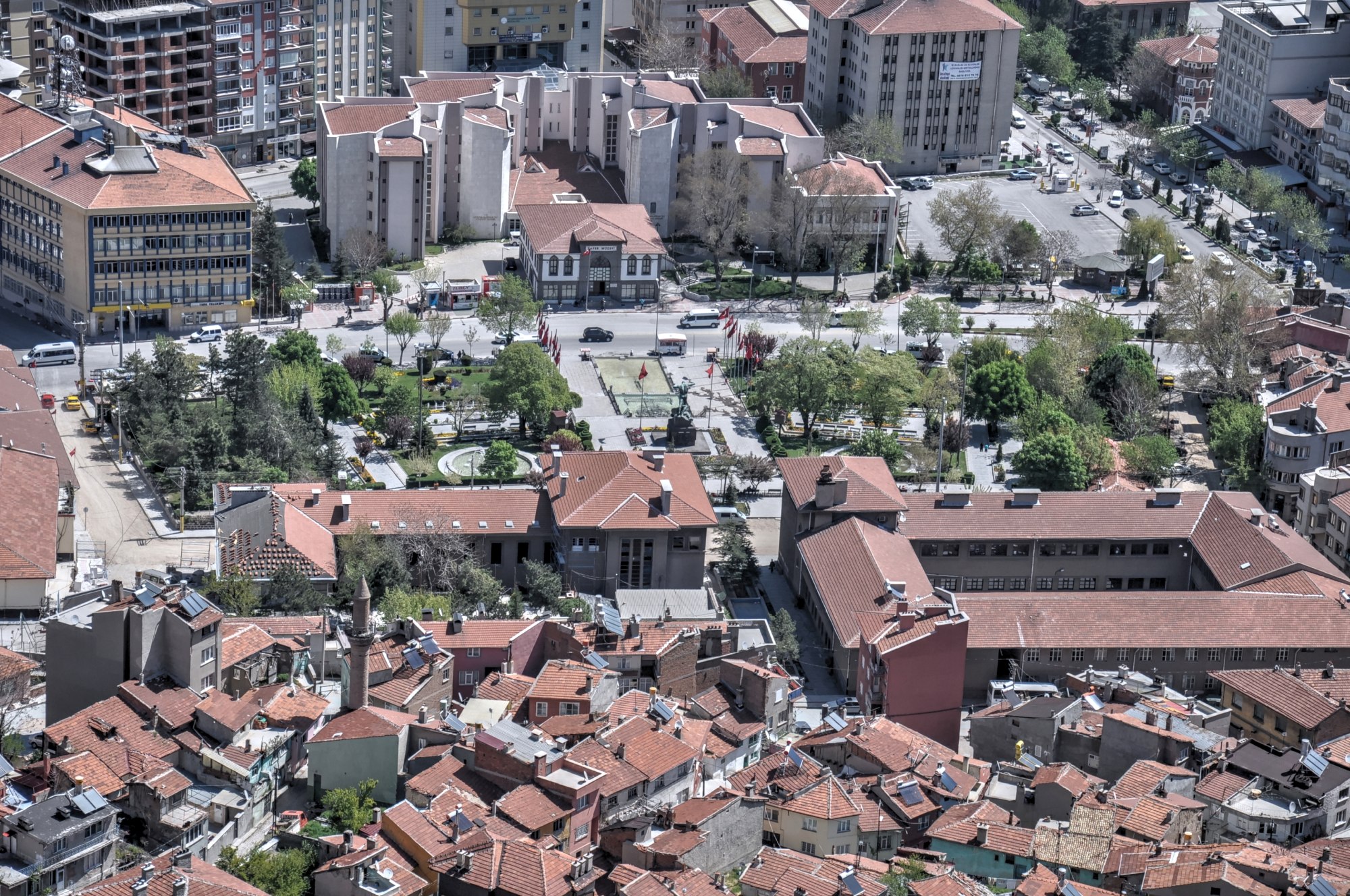
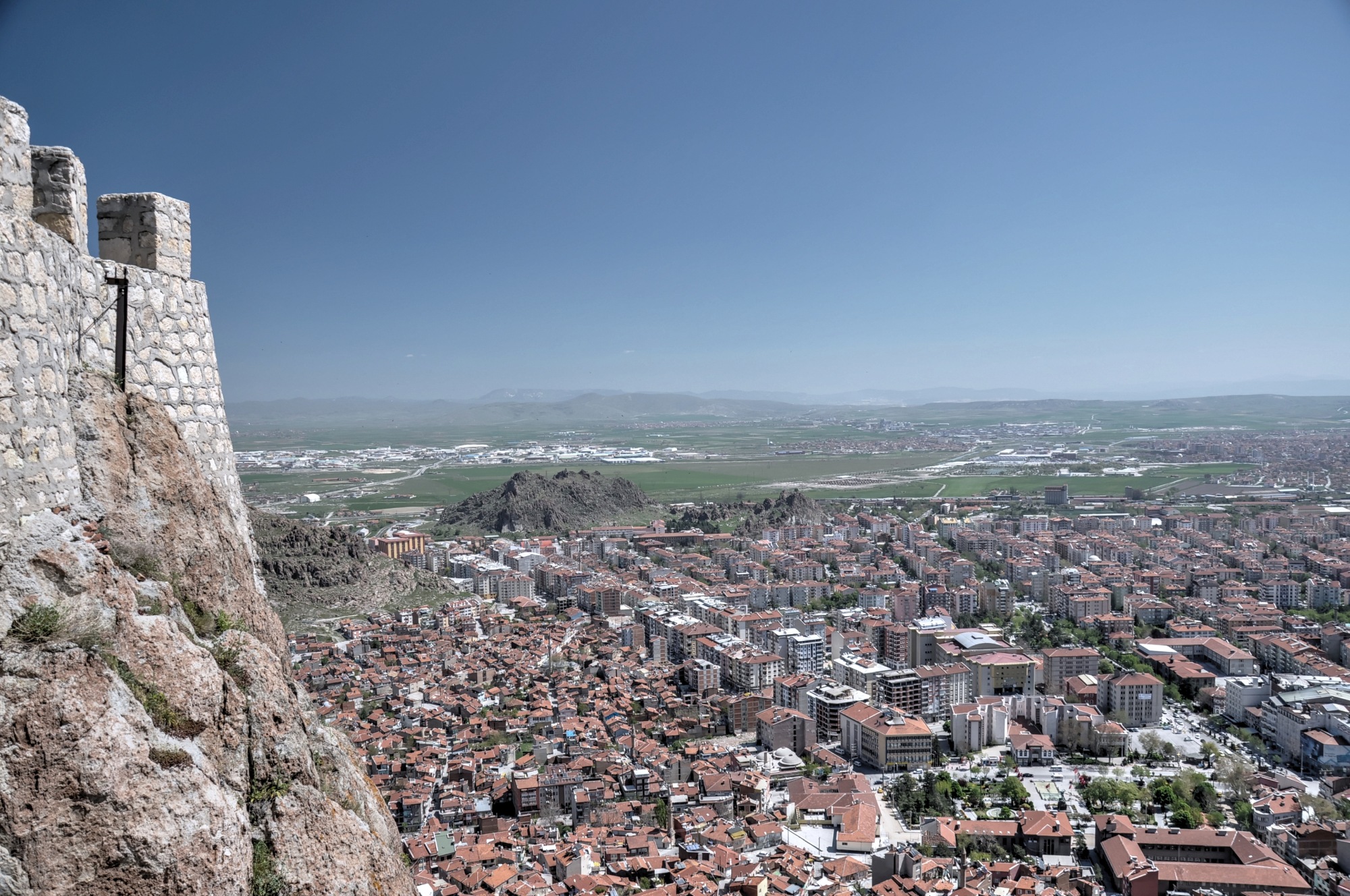
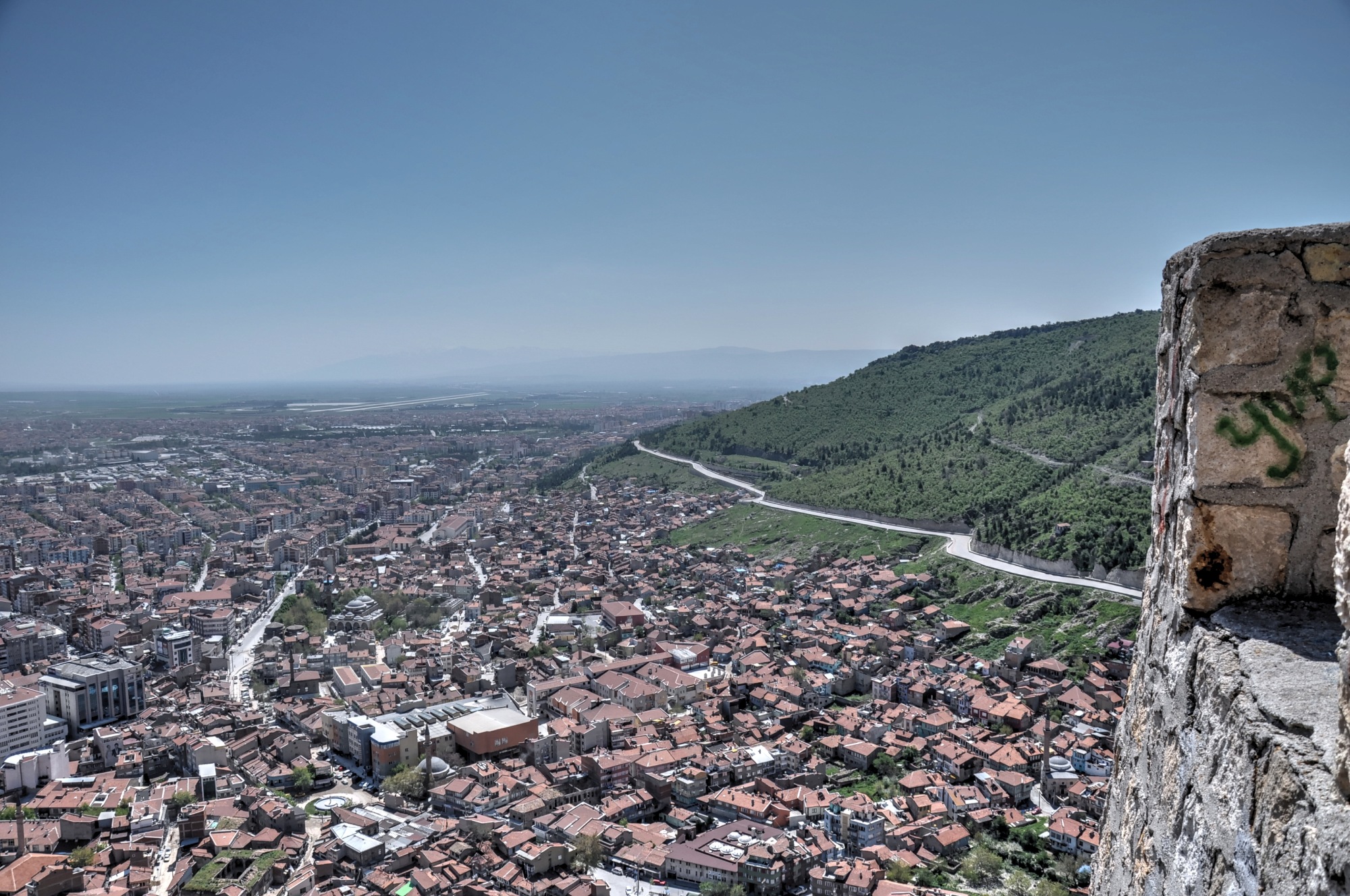
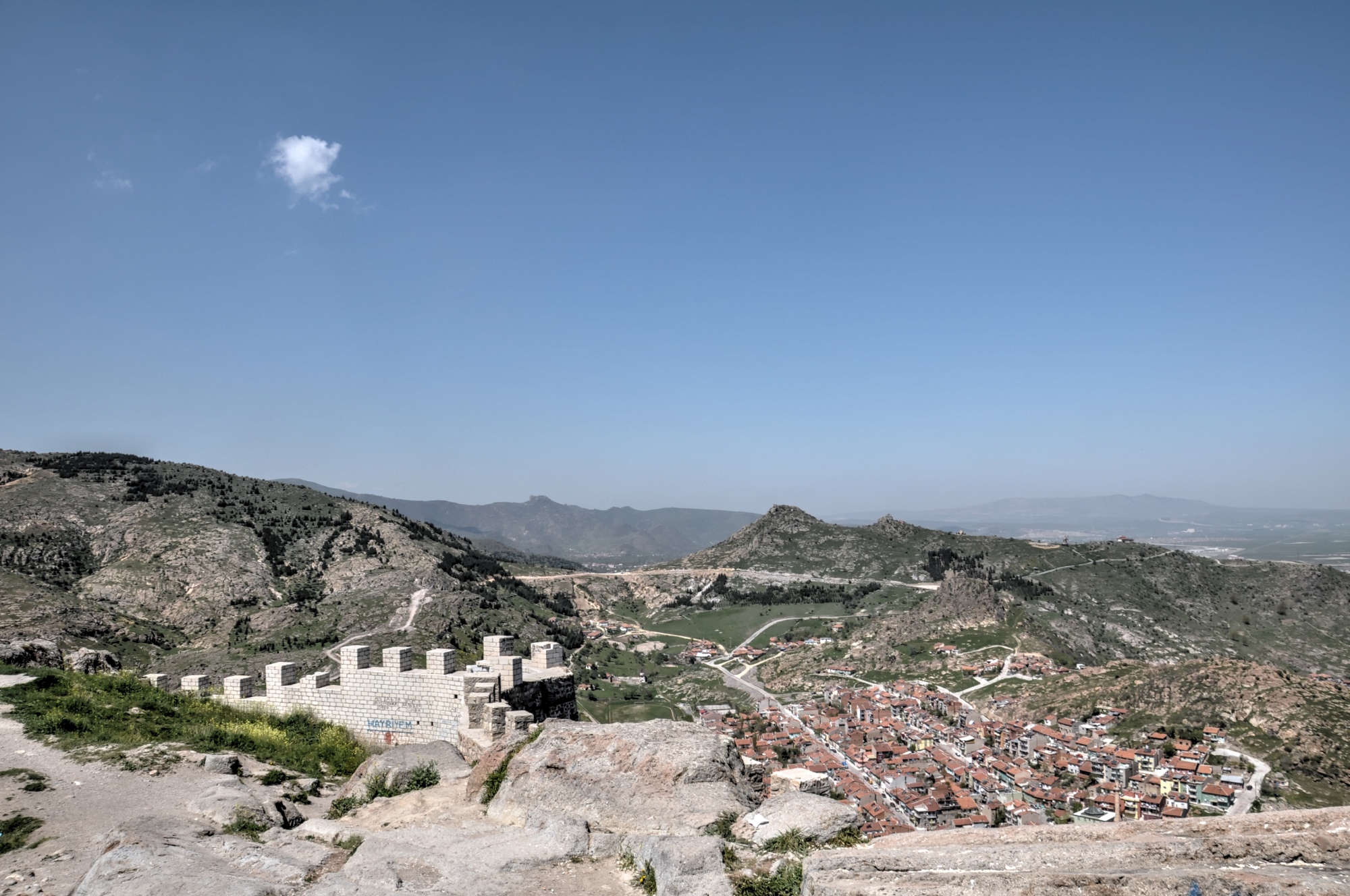
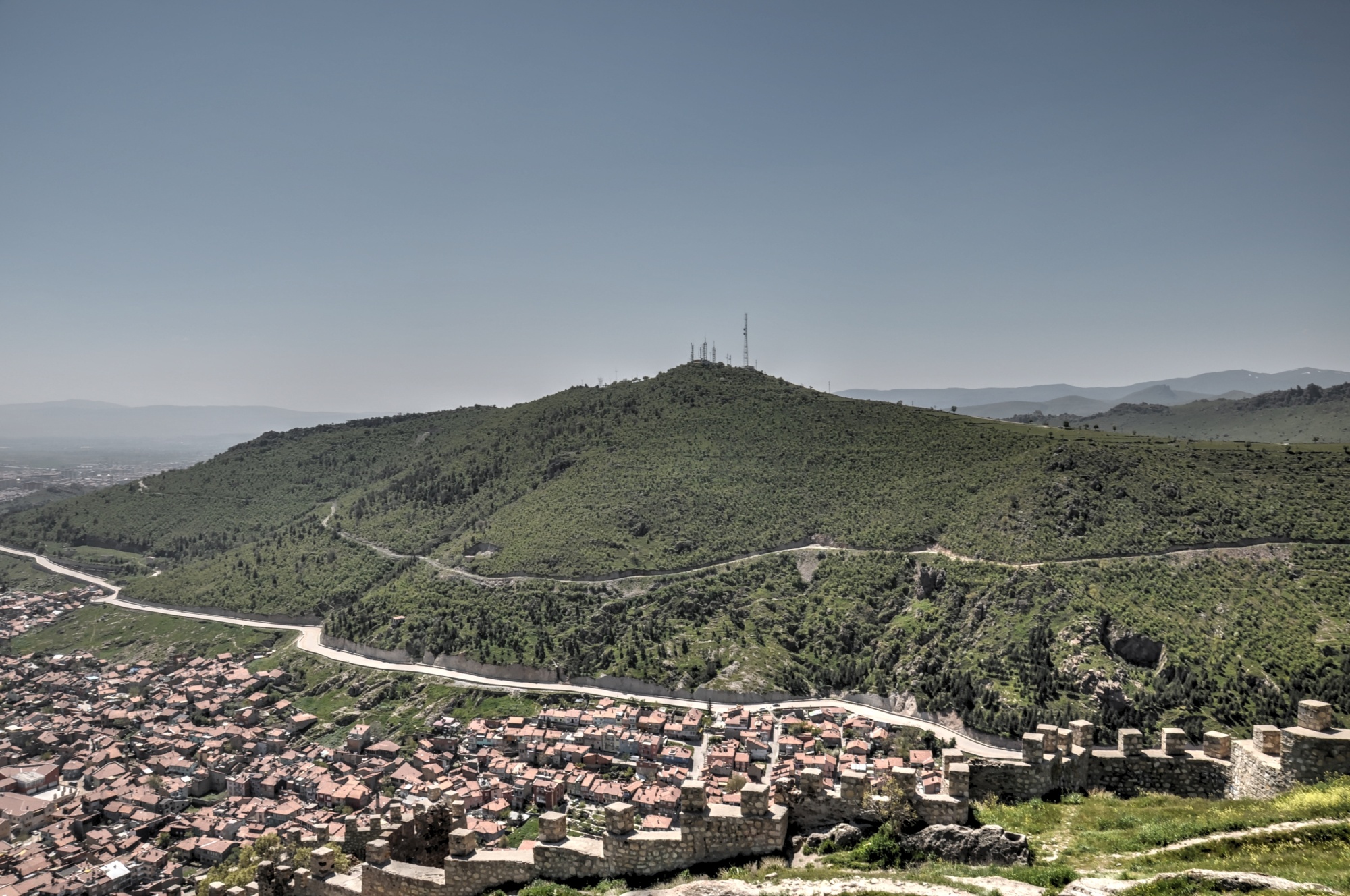
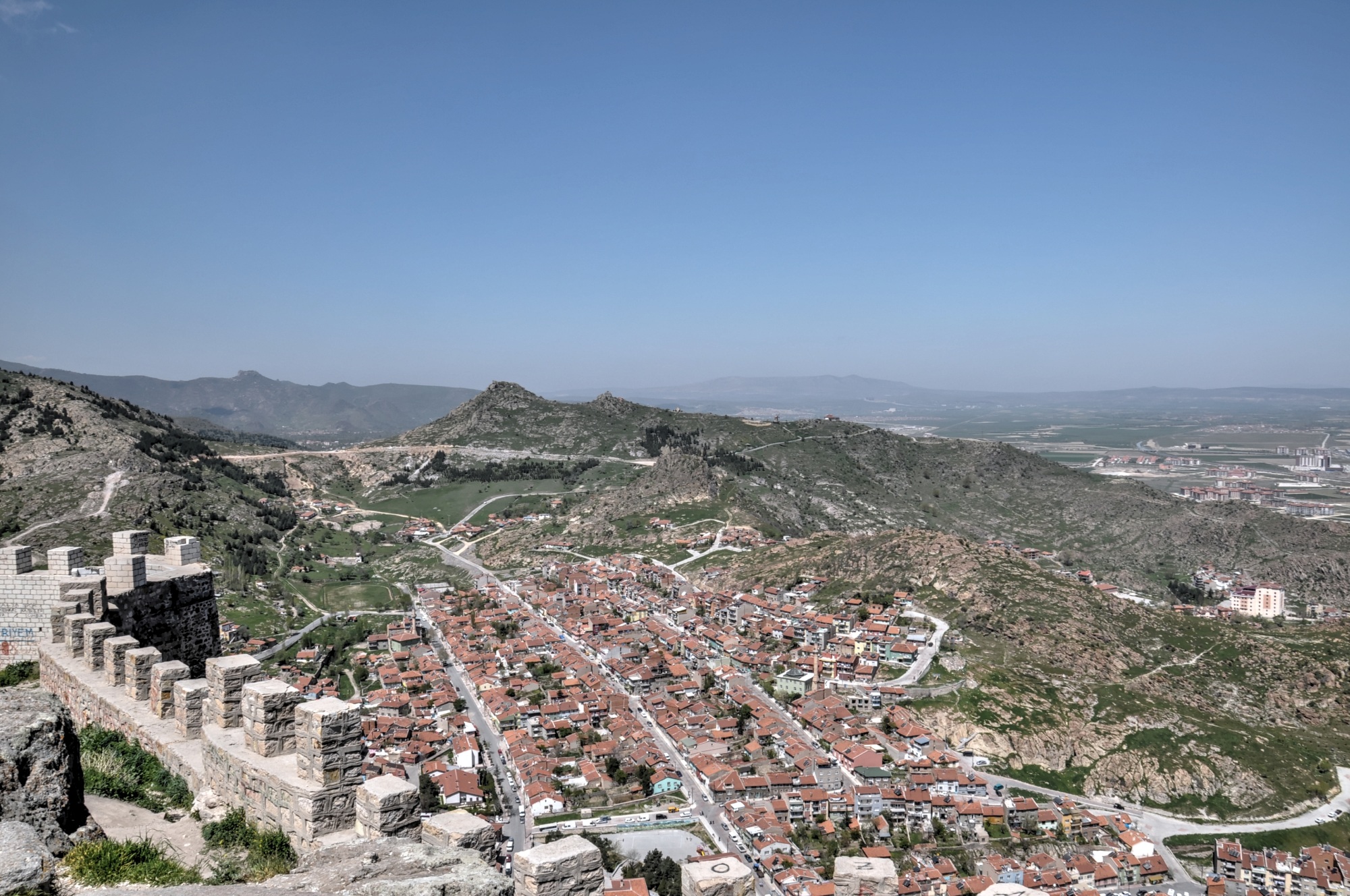
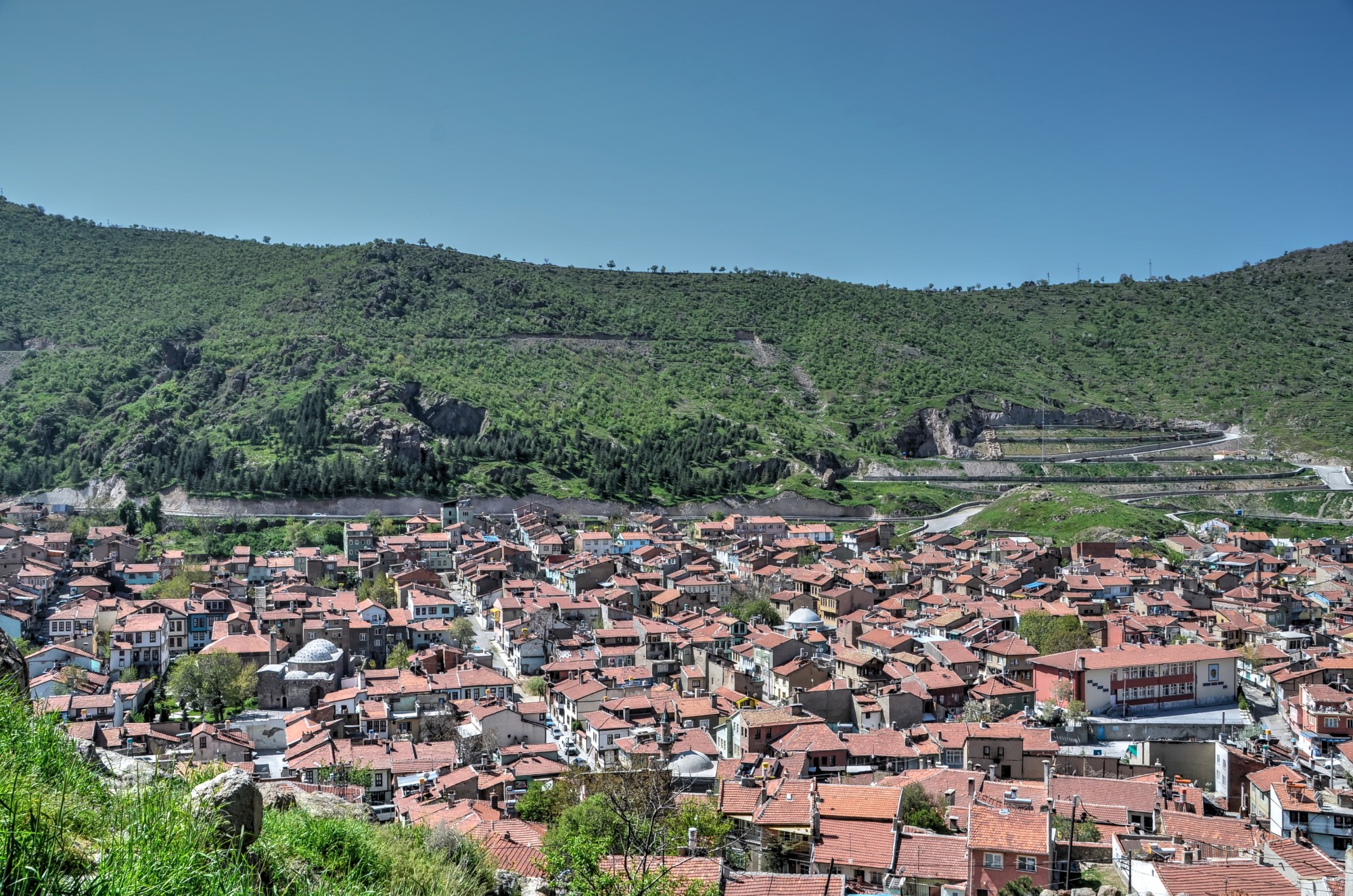
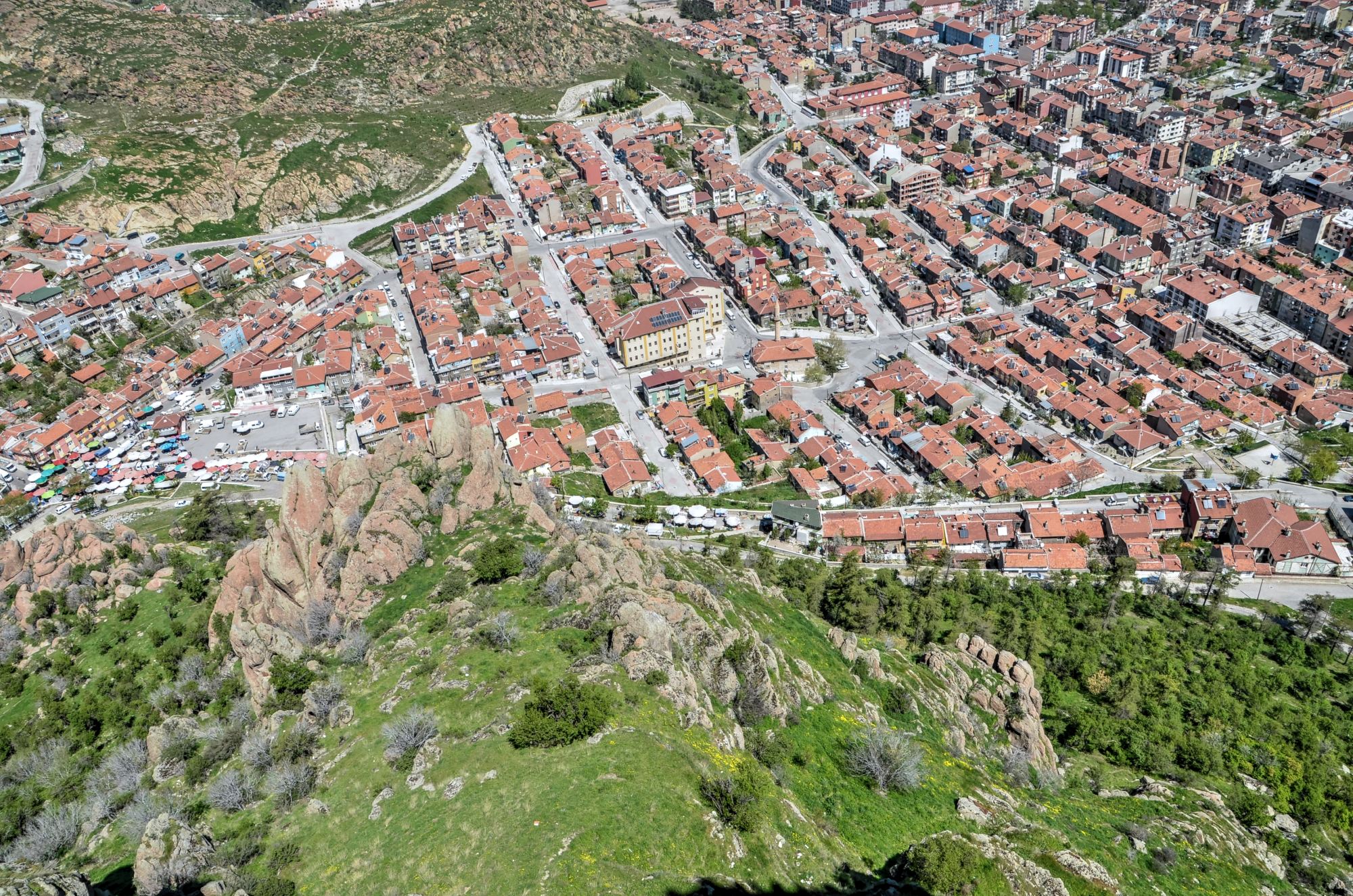
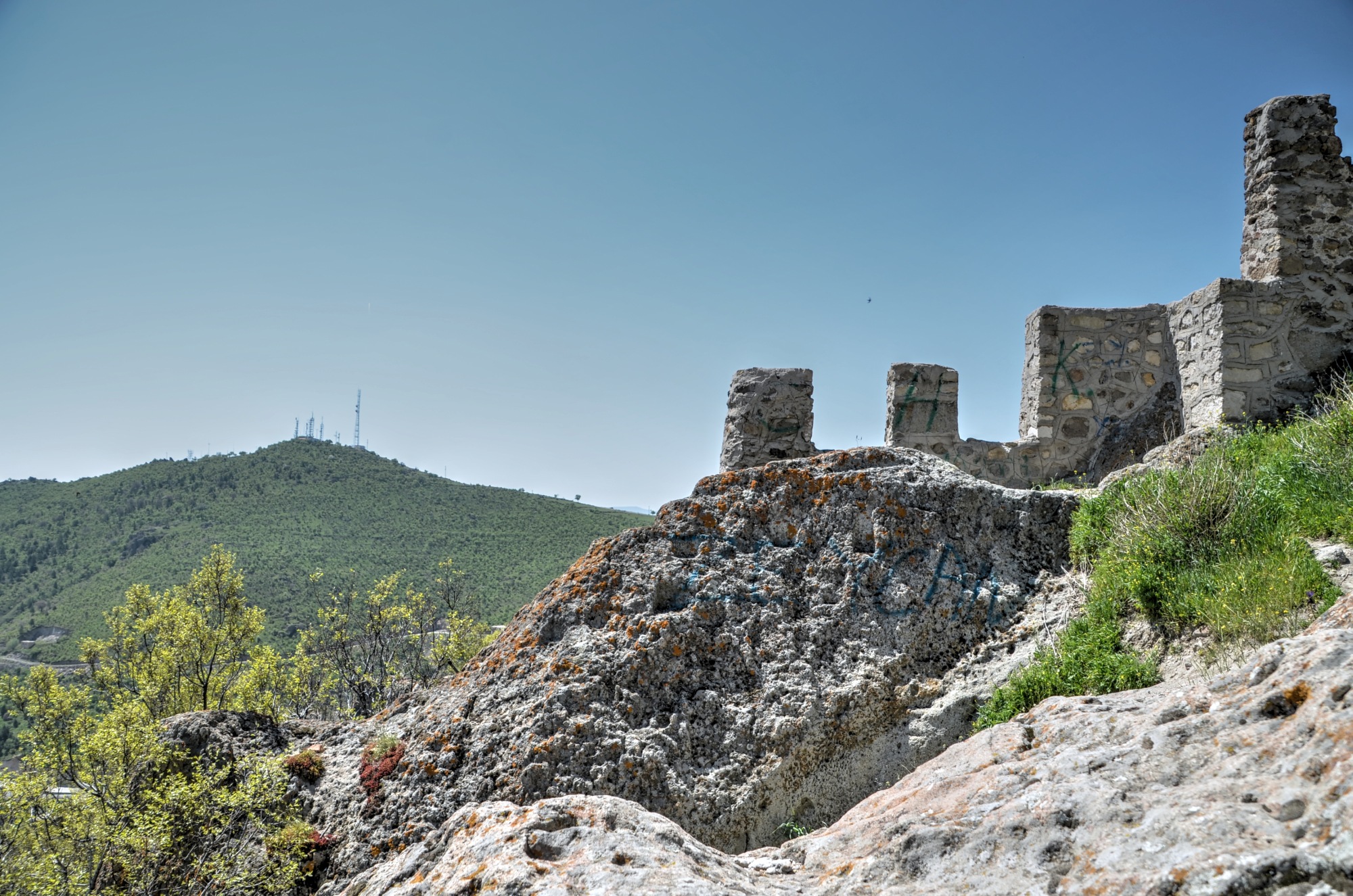
The summit is also worth exploring simply for its remarkable setting. The dark, steep-sided rock dominates the cityscape, and the views extend across Afyonkarahisar, its historic neighbourhoods, modern development, and the surrounding countryside. The combination of natural geology, archaeological remains, and surviving architectural features makes the castle one of the city's most distinctive landmarks and a site where the successive layers of its history can be appreciated.
Bibliography
- Afyonkarahisar Governor's Office. "Afyonkarahisar Kalesi." Official provincial website.
- Afyonkarahisar Municipality. "Afyonkarahisar Tarihi." Official municipal website.
- Afyonkarahisar Municipality. "Karahisar Kalesi." Municipal publication documenting the Seljuk reconstruction, inscription, and later history. PDF.
- Başarır, E., and N. Kun. 1982. "Afyon Kalesi Çevresindeki Volkanik Kayaçların Petrografik İncelemesi." KTÜ Yerbilimleri Dergisi 2(1–2): 87–96.
- Beckman, Gary, Trevor Bryce, and Eric Cline. 2011. The Ahhiyawa Texts. Writings from the Ancient World 28. Atlanta: Society of Biblical Literature.
- Belke, Klaus, and Norbert Mersich. 1990. Phrygien und Pisidien. Tabula Imperii Byzantini 7. Vienna: Österreichische Akademie der Wissenschaften, 177–178.
- Berndt-Ersöz, Susanne. 2003. Phrygian Rock-cut Shrines and Other Religious Monuments: A Study of Structure, Function and Cult Practice. Stockholm: Department of Classical Archaeology and Ancient History, Stockholm University.
- Bøgh, Birgitte. 2007. "The Phrygian Background of Kybele." Numen 54(3): 304–339. https://doi.org/10.1163/156852707X211573.
- Brixhe, Claude, and Thomas Drew-Bear. 1997. "Huit inscriptions néo-phrygiennes." In Frigi e frigio: atti del 1º Simposio Internazionale, Roma, 16–17 ottobre 1995, edited by R. Gusmani, M. Salvini, and P. Vannicelli. Rome: Consiglio Nazionale delle Ricerche.
- Bryce, Trevor R. 1974. "Some Geographical and Political Aspects of Mursilis' Arzawan Campaign." Anatolian Studies 24: 103–116.
- Cheynet, Jean-Claude, Thomas Drew-Bear, and Jean-Pierre Sodini. 2004. "Une inscription d'Akroïnos datant de Constantin Porphyrogénète." Revue des études byzantines 62: 215–228. https://doi.org/10.3406/rebyz.2004.2292.
- Çelik, M. Y. 2024. "Characterization of İscehisar Andesite (Afyonkarahisar-Turkey), Used as a Building Stone Source of Historical Heritages from Ancient Times to the Present." Geoheritage 16: article 71. https://doi.org/10.1007/s12371-024-00979-1.
- Ercan, T. 1986. "Orta Anadolu'daki Senozoik Volkanizması." MTA Dergisi 107: 119–140.
- Evliya Çelebi. Seyahatname, vol. IX, section "Evsaf-ı kal'a-i sengbâr şehr-i Afyon Karahisar." Original travel account.
- Işık, Fahri. 1991. "Karahisar ve Pentapolis'te 'Görülmeyen' Kybele İzleri." In II. Afyonkarahisar Araştırmaları Sempozyumu Bildirileri, 94–101.
- Kaya, Fevzi. 2013. "Karahisar Kalesi." Taşpınar, no. 10: 28–30. Afyonkarahisar Municipality.
- Kerman, Zeynep. 2002. "Evliya Çelebi'ye Göre Afyonkarahisar." Sosyal Bilimler Dergisi 4(1): 17–22.
- Köker, Büşra, and Seda Şimşek Tolacı. 2021. "Afyonkarahisar Kalesi Dönem Yapıları ve Eklerin Saptanması ve Analizi" ("Determination and Analysis of Afyonkarahisar Castle's Periodical Structures and Additions"). Akra Kültür Sanat ve Edebiyat Dergisi 9(25): 193–223. https://doi.org/10.31126/akrajournal.895406.
- Meriç, Recep. 2020. "The Arzawa Lands." TÜBA-AR 27.
- Morgan, Kathryn. 2024. "The Great Anatolian Melting Pot? Migration and State Formation at 'Phrygian' Gordion." Ancient Near Eastern Studies 61: 45–60. https://doi.org/10.2143/ANES.61.0.3294022.
- The Cambridge History of the Byzantine Empire, c. 500–1492. Reference work on the broader military context of Byzantine-Arab warfare and the Battle of Akroinon in 740.
- Roller, Lynn E. 1999. In Search of God the Mother: The Cult of Anatolian Cybele. Berkeley: University of California Press.
- Roller, Lynn E. 2012. "Phrygian and the Phrygians." In The Oxford Handbook of Ancient Anatolia: 10,000–323 BCE, 560–578. Oxford: Oxford University Press.
- Still, John. A Prisoner in Turkey. [Memoir of his captivity during the First World War]. Available online: Project Gutenberg.
- Topal, T., M. Akın, and U. A. Özden. 2007. "Assessment of Rockfall Hazard around Afyon Castle, Turkey." Environmental Geology 53(1): 191–200. https://doi.org/10.1007/s00254-006-0633-2.
- Türkiye Diyanet Vakfı. "Afyonkarahisar." TDV İslâm Ansiklopedisi. Online entry.
- UNESCO World Heritage Centre / ICOMOS. 2026. Report of the Joint World Heritage Centre/ICOMOS Advisory Mission to the Afyonkarahisar Ulu Mosque, a Component of the World Heritage Property "Wooden Hypostyle Mosques of Medieval Anatolia" (Türkiye), 17–18 February 2026. Official report.
- Yaşar, Selman. 2011. "Afyonkarahisar Folklorunda Kız Kulesi." The Journal of Academic Social Science Studies 4(2): 29–35.
Visitor tips:
Visiting Afyonkarahisar Castle requires considerable physical effort, as the ascent follows a steep staircase along the rocky slopes. Visitors should wear comfortable shoes with good grip and carry sufficient drinking water, particularly during the summer months, when the exposed climb can be tiring. Shade and resting places are limited along the route. Allow enough time to climb at a leisurely pace, explore the different sections of the fortress, and enjoy the views without rushing. The upper parts of the castle involve uneven surfaces and exposed rock, so care is advisable, especially after rain. The ascent may prove difficult for visitors with limited mobility. Admission to the castle is free, and no entrance ticket is required.
It is also worth combining the climb with a visit to the nearby Afyonkarahisar Grand Mosque (Ulu Cami), which was inscribed on the UNESCO World Heritage List in 2023 as part of the serial property Wooden Hypostyle Mosques of Medieval Anatolia. Dating to 1272–1277, the mosque is a notable example of Seljuk wooden-columned architecture.
Getting there:
Afyonkarahisar is an important road junction in western Anatolia and can be reached by intercity buses from major Turkish cities, including Ankara, Istanbul, İzmir, and Antalya. The city is also accessible by car via the country's main highway network. Intercity bus services arrive at Afyonkarahisar's bus terminal (otogar), from where travellers can continue to the city centre by local transport or taxi.
The starting point of the climb to Afyonkarahisar Castle is located in the historic centre, next to Afyonkarahisar Grand Mosque (Ulu Cami), at the foot of the volcanic rock. The entrance to the ascending path can be reached on foot from the central streets of the city, and the mosque provides a convenient landmark for finding the beginning of the route. Visitors arriving from elsewhere in Afyonkarahisar can reach the city centre by local bus or taxi, while those travelling by car may look for parking in the surrounding streets, although availability can be limited. The climb begins near the mosque, at approximately 38.755082, 30.529913, and continues uphill through the historic neighbourhood towards the fortress.
- Log in to post comments


